






The Heart of the Craft: Kumartuli
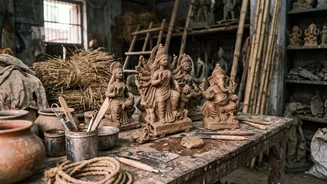
The soul of Durga Puja's artistry resides in the narrow, winding lanes of Kumartuli, the traditional potter's quarter in North Kolkata. For months leading up to the festival, these workshops are a hive of activity. Here, generations of skilled artisans,
known as 'kumars', give life to the divine. They meticulously craft thousands of clay idols of Goddess Durga, her children, and the demon Mahishasur, not just for the city but for communities across the globe. Walking through Kumartuli is like stepping into a living museum, where the air is thick with the smell of river clay and the sounds of creation echo through every alley. More than 450 workshops are clustered here, each a testament to a craft passed down through families.
From River Clay to Deity
The process of idol making is a sacred and systematic art. It begins with creating a bamboo framework, or 'kathamo', which acts as the idol's skeleton. Straw is then bound to this frame to create the rough form. The next stage involves applying clay, traditionally sourced from the banks of the river Ganga, in several layers. A mixture of sticky clay ('entel mati') and rice husk is used for the base, followed by a smoother finish with finer clay ('bele mati'). The faces, palms, and feet are often made separately using moulds to meet the huge demand before being attached to the body. The final, most powerful moment is 'Chokkhudaan'—the bestowing of the eyes. Performed on Mahalaya, the day that ushers in the festival, artisans paint the eyes, an act believed to breathe life and divine energy into the idol.
The Pandal: A Temporary Universe
The idols are housed in magnificent temporary structures called 'pandals'. These are far more than just shelters; they are immersive, themed installations that showcase incredible creativity and architectural ambition. Each year, neighbourhood clubs and communities vie to create the most innovative and talked-about pandal, with themes ranging from replicas of historical monuments like the Victoria Memorial to commentaries on social issues and environmental conservation. Built primarily from bamboo, cloth, and other materials like sculpted foam, these temporary marvels turn entire streets into artistic zones, drawing millions of 'pandal-hoppers' who wander the city to admire the different creations.
Chandannagar's Wizards of Light
The spectacle of Durga Puja is amplified by its dazzling illumination, an art form perfected by the light artists of Chandannagar, a former French colony near Kolkata. These 'light wizards' are renowned for their creative and dynamic light displays. Using thousands of LED bulbs strung on wires, they create shimmering arches, gates, and panels that often depict moving figures and tell stories, from mythology to contemporary events. The tradition of innovative lighting, pioneered by artists like Sridhar Das, has made Chandannagar's contribution an inseparable part of the Puja's visual identity, turning night into a vibrant canvas of light.
Delicate Decor: The Art of Sholapith
Adding to the idol's divine aura is the intricate, milky-white decoration known as 'sholar saaj'. This is the craft of Sholapith, where artisans carve the soft, spongy stem of the shola plant—a marshy aquatic herb—into exquisite ornaments. The white colour is considered auspicious and pure. The artisans, known as 'Malakars', use sharp knives to skilfully shape the delicate material into crowns ('mukut'), massive earrings, necklaces, and other adornments for the deity. Traditionally used for the idol's entire decoration ('daaker saaj'), Sholapith work is a testament to the minute, patient craftsmanship that complements the grand scale of the festival.