







A Historic Leap into Orbit
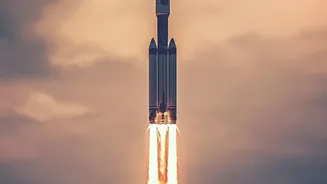
Hyderabad-based Skyroot Aerospace made history in July 2026, becoming the first private Indian company to successfully launch a rocket, the Vikram-1, into Earth's orbit. This landmark achievement, dubbed 'Mission Aagaman' (Arrival), placed India in an elite
club with the United States and China as nations with private orbital launch capability. Founded in 2018 by former ISRO scientists, Skyroot had already proven its mettle with a suborbital flight in 2022. But the successful flight of the seven-story-tall Vikram-1, which deployed several small satellites into a 450-km orbit, was a monumental step, transforming the company into a globally recognized player. This success wasn't just a technical victory; it was the culmination of years of policy reform designed to open India's space sector to private enterprise.
Mastering the Workhorse
The Vikram-1 is Skyroot’s current workhorse. It is designed specifically for the booming small satellite market, capable of carrying payloads of about 350 kg to Low Earth Orbit. CEO Pawan Kumar Chandana has called this the “sweet spot” for the market. Following the successful inaugural launch, the company's immediate goal is not to rush toward a bigger rocket, but to perfect the process with Vikram-1. In an interview, Chandana stated the objective is to build rockets reliably and at scale, targeting a launch cadence of one mission per month by the next year. This strategy underscores a fundamental truth of the launch business: for customers sending expensive satellites into space, a company’s track record of reliability is its most important asset. One successful launch is a milestone, but a sequence of them is a business.
Why Consistency Is King
In the commercial space industry, launch consistency is the ultimate currency. Satellite operators, from telecommunication giants to Earth-observation startups, need to be certain that their multi-million-dollar assets will reach orbit safely and on schedule. A single failure can be catastrophic for both the launch provider and its clients. By prioritising a regular, reliable launch schedule, Skyroot aims to build deep-seated trust with its customers. According to company leadership, the market truly opens up after two successful orbital launches, as this is when customer confidence solidifies. This focus on dependability over sheer size is a sign of a mature business strategy. It allows Skyroot to streamline its manufacturing, which it says is already capable of producing one rocket per month, and build a strong revenue stream. A consistent launch record will become one of the company's most valuable assets, helping it compete in a crowded global market.
The Vision for a Larger Rocket
The focus on consistency with Vikram-1 does not mean Skyroot has curbed its ambitions. On the contrary, it’s a stepping stone. The company has already laid out plans for its next vehicle: the Vikram-II. This larger rocket, powered by a cryogenic engine, is designed to carry payloads of up to 900-1,000 kg, nearly three times the capacity of its predecessor. With a target debut in 2027, Vikram-II will allow Skyroot to service a wider range of customers, including those with heavier satellites or those looking to deploy entire constellations in one go. The company is also working on a fully reusable launch vehicle for the long term, which would dramatically reduce launch costs. This phased approach—mastering the small launcher, then scaling up—is a proven model for sustainable growth in the capital-intensive space industry.
Fueling India's Space Ambition
Skyroot’s strategy is perfectly aligned with India's larger goals. The government's decision to open the space sector to private players in 2020 was aimed at creating a vibrant ecosystem where companies like Skyroot could thrive. With an $8.4 billion space economy projected to grow to $44 billion by 2033, reliable private launch providers are critical. By focusing on cadence and reliability, Skyroot is not just building its own business; it's building essential infrastructure for the entire Indian space industry. This allows satellite manufacturers, application developers, and other startups to plan their businesses with confidence, knowing there is an indigenous, dependable, and cost-effective pathway to orbit. Skyroot's success reinforces India’s emergence as a major, and increasingly private, force in the global space economy.