



Our Cosmic Next-Door Neighbour
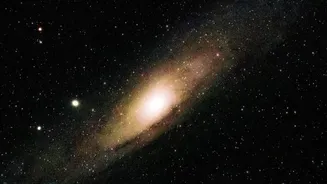
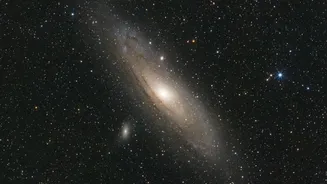
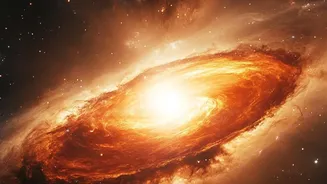
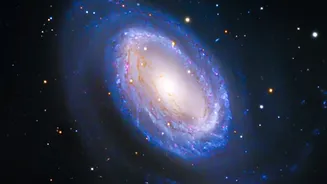
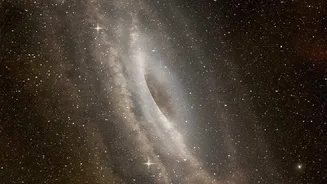
At a distance of 2.5 million light-years, the Andromeda galaxy, also known as M31, is the closest major spiral galaxy to our own Milky Way. Visible to the naked eye from dark locations, it provides a unique opportunity for astronomers. Because we are
situated inside the Milky Way, getting a complete, outside-in picture of our own galaxy is impossible. Andromeda, however, can be viewed in its entirety, allowing scientists to study its structure and history in stunning detail, offering a proxy for understanding our own galactic home. Recent studies have focused on this proximity to conduct a kind of galactic archaeology, using stars as a fossil record to piece together Andromeda's past.
Hubble’s Unprecedented Survey
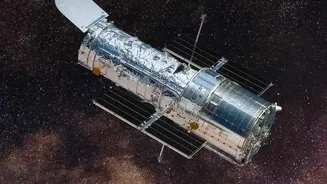
To unlock these secrets, astronomers have relied on the unparalleled vision of the Hubble Space Telescope. Two massive observation campaigns, the Panchromatic Hubble Andromeda Treasury (PHAT) and its southern counterpart (PHAST), have combined to create the most comprehensive map of Andromeda ever assembled. These surveys meticulously imaged roughly two-thirds of the galaxy's sprawling disk, resolving an incredible 200 million individual stars. By analyzing the light from these stars—noting that massive, young stars burn bluer while older, less massive stars are redder—scientists can determine the history of star formation across different regions of the galaxy with incredible precision.
A Galaxy Winding Down
The latest findings, published in The Astrophysical Journal in July 2026, reveal a dramatic slowdown. Researchers discovered that Andromeda’s rate of star formation has been in a steady decline for the last 500 million years, with an even steeper drop in the last 40 million years. Around 500 million years ago, Andromeda was creating stars at a rate of about one solar mass per year, similar to the Milky Way's current rate. Today, that rate has plummeted to just one-fifth of a solar mass per year. This suggests the galaxy is in a wind-down period, slowly settling into a quieter phase of its life.
Clues of a Violent Past
This current slowdown appears to be the aftermath of a far more turbulent era. Previous research has shown that Andromeda experienced a massive burst of star-making activity about two billion years ago. This starburst was likely triggered by a significant event, such as a merger with another, gas-rich galaxy. Such collisions can compress vast clouds of interstellar gas and dust, providing the raw fuel to kick-start intense bouts of star formation. The current decline is not due to a lack of fuel, but rather seems to be a natural tapering off after that ancient, frenetic period. Most of the recent star-making activity has been concentrated in a ring about 32,000 light-years from the galaxy's centre, and it is the slowing activity in this ring that is driving the overall decline.
A Likely Suspect
Scientists are also investigating more recent interactions that may have influenced Andromeda's star formation. One prime suspect is M32, a small, compact satellite galaxy that orbits Andromeda. The new Hubble data allowed the team to study the star formation history in the region of Andromeda's disk closest to M32. They found signs of decreased star formation in this area that began roughly 60 million years ago. While researchers cannot definitively say that M32 is the cause, its proximity and the timing make it the most likely culprit for this localized dip in activity.