



The New Official Height
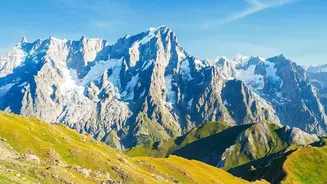
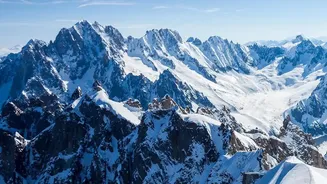
Following their biennial survey, a team of French surveyors announced this week that Mont Blanc now officially stands at 4,805.20 metres. This marks a slight decrease from the 4,805.59 metres recorded during the previous measurement in 2023. For the experts
who trek up the mountain every two years, this fluctuation is not a surprise. The summit of Mont Blanc is a thick cap of permanent ice and snow, meaning its height is in a constant state of flux, shaped by the weather at its peak. The measurement expeditions, which have been happening for over two decades, provide a crucial health check on this iconic landmark, revealing more than just a simple number.
Science at the Summit
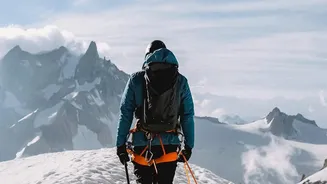
So, how does one measure a mountain? It’s a far more complex process than simply using a giant ruler. A team of around 20 specialists, known as geometer-experts, makes the arduous climb every two years. Once at the summit, they use high-precision tools, including Global Navigation Satellite System (GNSS) antennas, to record the exact altitude of the snow-covered peak. The process takes several hours in freezing temperatures and thin air. For the most recent surveys, the team has also employed a drone equipped with a scanner. This allows them to create a precise 3D model of the summit and calculate the volume of the ice cap, all without having to spend as much time in the hazardous 'death zone' above 4,800 metres.
A Tale of Two Summits
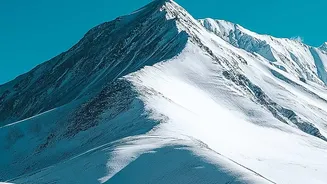
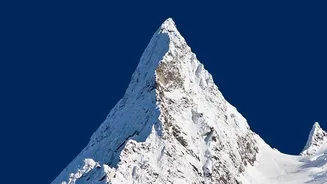
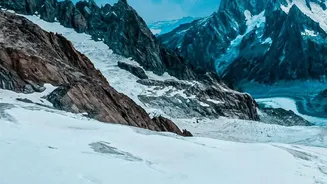
The key to understanding Mont Blanc's changing height lies in distinguishing between its two summits: one of rock, the other of ice. The mountain's rocky peak is stable, sitting at 4,792 metres above sea level. However, the official 'height' that makes headlines is the top of the thick layer of snow and 'eternal' ice that covers this rock. This snowy crown can be over 15 metres thick. Its altitude changes based on how much snow accumulates and, more importantly, how the wind sculpts it. The biennial measurement is therefore not a measurement of the mountain itself, but a snapshot of its ever-shifting icy mantle.
The Weather's Deciding Vote
While it’s tempting to immediately link a lower summit to climate change, the surveyors are quick to point out that the primary driver of change between surveys is the weather. The height variation is largely due to precipitation and wind at high altitudes. A summer with less snowfall or, more significantly, strong winds at the summit can 'scour' snow from the peak, effectively lowering it. Conversely, a season with heavy snow and calmer winds can lead to a higher measurement. For instance, the record height of 4,810.90 metres, set in 2007, came after a period of significant snow accumulation. Surveyors believe the recent decrease is likely linked to specific weather patterns over the past two years, rather than a standalone indicator of glacial melt.
The Broader Climate Question
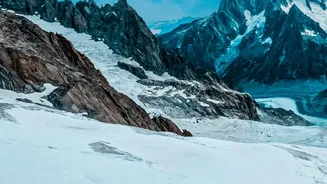
Although short-term weather is the main culprit for the two-year fluctuations, scientists are indeed watching Mont Blanc for signs of climate change. The real story, they say, is not in the height of the summit but in the total volume of the ice cap. By using drone photogrammetry and other techniques, the team can now precisely calculate this volume. Tracking how this figure changes over a decade or more will provide much clearer evidence of climate change's impact on the Alps' glaciers. In essence, the height is a catchy number that grabs our attention, but the volume is the critical data point for understanding the long-term health of the mountain in a warming world. The data collected in 2026 will be added to a growing library of information that helps us monitor these crucial changes.