


Meet the New Eye on the Sky
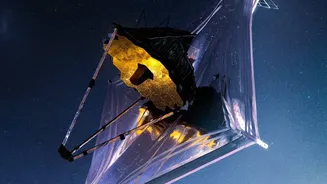
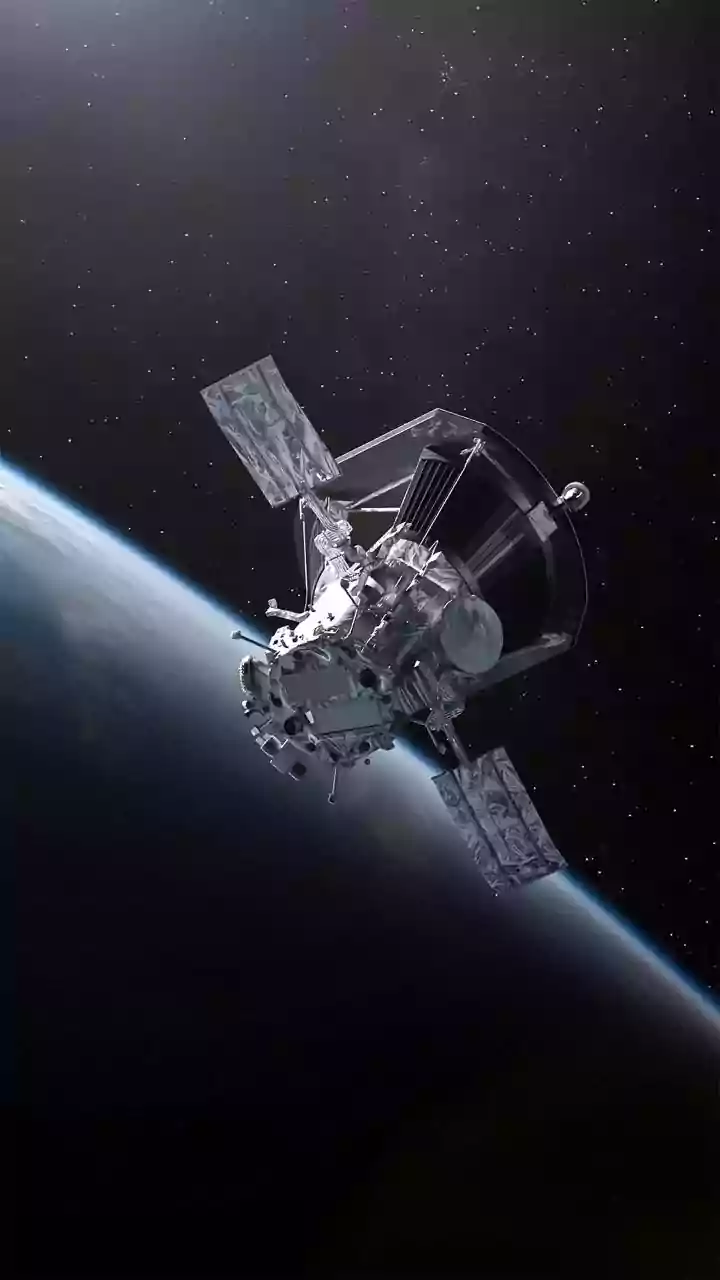
The Nancy Grace Roman Space Telescope is NASA's latest flagship observatory, launched in August 2026 to tackle some of the biggest questions in astrophysics. Named after NASA's first chief of astronomy, the 'mother of Hubble' Nancy Grace Roman, this telescope
is designed for discovery on a grand scale. While telescopes like Hubble and Webb provide stunning, deep-dive portraits of small patches of sky, Roman is built for breadth. Its primary tool, the Wide Field Instrument, has a field of view 100 to 200 times greater than Hubble's, allowing it to map huge swathes of the cosmos with the same incredible sharpness but thousands of times faster. Think of it as the difference between a zoom lens and a panoramic camera; Roman will create the largest cosmic maps ever, providing the big-picture context for the universe's evolution.
The Dark Energy Detective
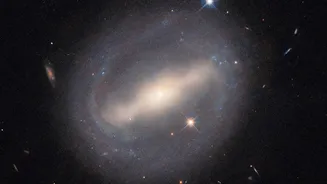
One of Roman's main jobs is to investigate dark energy, the mysterious force that makes up roughly 68% of the universe and is responsible for its accelerating expansion. This acceleration was a shocking discovery in the late 1990s, and understanding its cause is a top priority for physicists. Roman will attack this problem from multiple angles. It will conduct vast surveys to measure how the universe's expansion rate has changed over billions of years. By tracking the distribution and movement of millions of galaxies, Roman will help scientists determine if dark energy is a constant force or if its strength has evolved over cosmic time, which holds clues to the ultimate fate of the universe.
Standard Candles: Exploding Stars
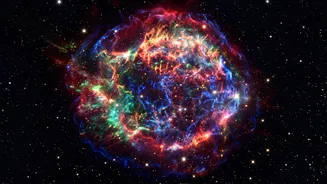
A key technique for measuring cosmic distances involves a specific type of exploding star called a Type Ia supernova. These explosions occur in binary star systems containing a white dwarf and always detonate with a predictable, uniform brightness, making them excellent 'standard candles'. By comparing how bright a supernova appears from Earth to its known intrinsic brightness, astronomers can calculate its distance with high precision. Roman's High-Latitude Time-Domain Survey will be a supernova-hunting machine, expected to find thousands of them, some dating back to when the universe was only a few billion years old. This massive new dataset will allow for unprecedentedly accurate measurements of cosmic expansion across different epochs.
Echoes of the Early Universe
Roman will also use a clever method involving echoes from the dawn of time. In the very early universe, the cosmos was filled with a hot, dense soup of particles. Sound waves rippling through this primordial fluid, known as Baryon Acoustic Oscillations (BAOs), left a subtle imprint on the distribution of matter. This created a standard length scale throughout the cosmos; for any galaxy, there's a slightly higher probability of finding another at a specific distance—about 500 million light-years away today. By mapping the positions of millions of galaxies, Roman will measure this preferred spacing at different cosmic times. Because that distance stretches as the universe expands, BAO measurements provide another powerful, independent ruler to chart the history of cosmic expansion and probe the effects of dark energy.