





Meet the Milky Way's First 'Microblazar'
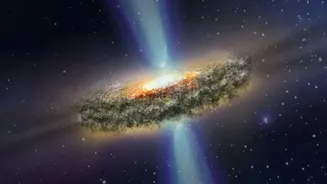
The object of intense study is IRAS 18293-0941, and it's not a black hole itself, but something arguably just as fascinating. It is a binary system where a massive, hot star and a stellar-mass black hole are locked in a cosmic dance, orbiting each other
every 11 days. For over 30 years, scientists have predicted the existence of 'microblazars' in our galaxy — smaller, local versions of the gigantic blazars seen in the distant universe. A blazar is an active galactic nucleus powered by a supermassive black hole that shoots a jet of plasma directly towards us. A microblazar does the same, but with a much smaller, star-sized black hole. IRAS 18293-0941 is the first object found in the Milky Way that fits the description, making it a landmark discovery. It was first cataloged in 1983 but was hidden from detailed view by thick interstellar dust until recent observations with powerful radio telescopes like MeerKAT pierced the veil.
A Jet Pointed Toward Earth
What makes this system so special is its orientation. As the black hole strips material from its companion star, it doesn't swallow everything. Instead, it channels a portion of this matter into two powerful, opposing jets of plasma that erupt from its poles at about 75% of the speed of light. Crucially, one of these jets is pointed almost directly at Earth. This alignment is a cosmic coincidence of immense scientific value. Due to an effect called relativistic beaming, material moving towards an observer at such high speeds appears dramatically brighter, while the jet moving away becomes almost invisible. This is why IRAS 18293-0941 looks like it has only one jet and why it qualifies as a microblazar candidate. Despite the dramatic-sounding headline of a black hole jet aimed our way, the system poses no threat; at 12,000 light-years away, it is a scientific curiosity, not a danger.
A Laboratory for Extreme Physics
Studying supermassive black holes at the centers of distant galaxies is like trying to inspect a car engine from a different city. Microblazars like IRAS 18293-0941 bring the laboratory into our own galactic backyard. Scientists can use this system to get a much closer look at how black hole jets are formed and launched. These jets play a fundamental role in how galaxies evolve, transporting enormous amounts of energy and matter across vast distances. Understanding the physics of the jet in IRAS 18293-0941—how it's collimated into a narrow beam and accelerated to near-light speed—provides direct insight into the same processes happening on a much grander scale in blazars millions of light-years away. It helps answer long-standing questions about how black holes of all sizes influence their environments.
Clues to Cosmic Rays
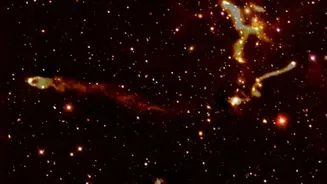
The research on IRAS 18293-0941 has implications beyond black hole mechanics. While the jet aimed at Earth is bright and observable, its counterpart is just as important. Astronomers have found evidence that the receding jet, aimed away from us, is slamming into a dense molecular cloud. This colossal impact creates a 'hotspot' that is a prime candidate for accelerating particles to incredible speeds, creating what are known as ultra-high-energy cosmic rays. The origin of these highly energetic particles that bombard Earth's atmosphere has been a long-standing mystery. Researchers have noted a spatial coincidence between the jet's impact zone and a source of ultra-high-energy gamma rays, suggesting this microblazar could be one of the cosmic accelerators they have been searching for.