



A Celestial Lion's Roar
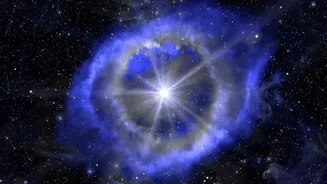
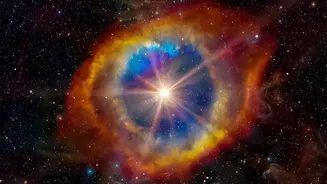
The latest celestial masterpiece from the James Webb Space Telescope captures the Lion Nebula, also known as NGC 2392, in stunning new detail. Located thousands of light-years away, this planetary nebula gets its name from its resemblance to a lion's
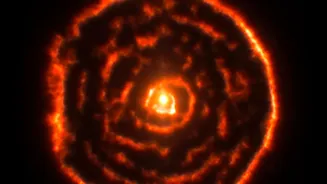
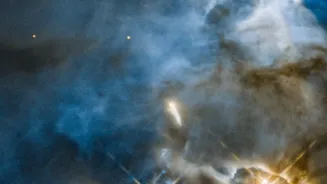
head, complete with a flowing mane of gas and dust. At its heart lies a dying star, a white dwarf, whose intense energy sculpts the surrounding clouds into the magnificent structure we see. While the Hubble Space Telescope gave us a glimpse in visible light, Webb’s new portrait, taken with its powerful near- and mid-infrared instruments, cuts through the cosmic haze to reveal the intricate dance of gas and dust with remarkable clarity. We can now see the cavernous bubbles and shell-like rings of ionized gas that form the lion's 'face', and the delicate, comet-like tails of dust that make up its 'mane'.
The Superpower of Infrared Light
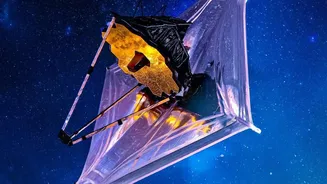
So, what makes Webb’s infrared vision so special? Think of it as a pair of cosmic x-ray glasses. Much of the universe, including stellar nurseries like the Lion Nebula, is shrouded in thick clouds of cosmic dust. To a telescope that sees in visible light—the same light our eyes detect—these dust clouds are opaque, like a thick fog, obscuring the wonders within. Infrared light, however, has a longer wavelength that can pass through these dense dust clouds much more easily. This allows Webb to peer into regions of space that are completely hidden from other telescopes. It can see the faint heat glow of newly forming stars and planets that are not yet hot enough to shine brightly in visible light. This ability to see the 'unseen' is revolutionizing our understanding of how stars are born and how they interact with their environment.
Anatomy of a Dying Star
The Lion Nebula is what's known as a planetary nebula, which, despite the name, has nothing to do with planets. It’s the beautiful, glowing shell of gas ejected by a star like our sun in its final stages of life. The central white dwarf in NGC 2392 is incredibly hot, and its fierce radiation is 'cooking' the surrounding material from the inside out. This process creates the bubble of ionized gas that forms the nebula's core. Webb’s image reveals how this expanding bubble is destroying some dust while other, denser filaments manage to survive, creating the complex textures we see. The 'mane' is essentially an outer shell of dust being illuminated by the central star, with some clumps protecting the material behind them, creating beautiful, stream-like features.
A Snapshot in Cosmic Time
While the image appears static, it captures a dynamic and fleeting cosmic event. The structures within the Lion Nebula have taken thousands of years to form and are constantly changing as gas and dust are pushed away from the central star. Astronomers estimate that the entire nebula will disperse into space in about 10,000 years—a mere blink of an eye in astronomical terms. Each image from Webb is therefore a precious snapshot, freezing a moment in the dramatic life cycle of a star. By studying these details, scientists can better understand the processes that enrich the galaxy with heavier elements, which are the building blocks for future stars, planets, and even life itself. This portrait is not just a pretty picture; it's a key piece of the puzzle in understanding our own cosmic origins.