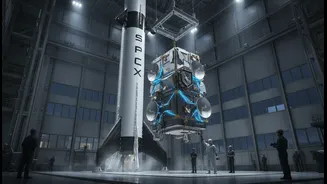








More Than Just an Internet Provider
When most people think of SpaceX's Starlink, they picture a vast constellation of satellites beaming internet down to Earth. But built into this network is a powerful, often-overlooked capability: immense computational power. Each of the thousands of satellites is a sophisticated
computer, and recent reports indicate SpaceX is in talks with the U.S. Department of Defense about leasing this capacity. This wouldn't be internet service, but rather a form of in-space cloud computing, sometimes called "platform-as-a-service." Instead of sending massive datasets from sensors, drones, or satellites down to Earth for analysis, the Pentagon could process that data directly in orbit using SpaceX's network. This concept is at the heart of Starshield, a separate business unit SpaceX created specifically for government and national security clients.
SpaceX's Orbital Advantage
SpaceX is uniquely positioned to offer this service. The company operates the world's largest satellite constellation by a massive margin. More importantly, its newer satellites are connected by optical laser links, creating a high-bandwidth mesh network in space. This allows data to hop from satellite to satellite at the speed of light, bypassing slower and more vulnerable ground stations entirely. The company's next-generation V3 Starlink satellites, designed for launch on Starship, dramatically increase this capacity, with each node reportedly capable of handling terabits of data. This creates a resilient, distributed supercomputer in low-Earth orbit. As SpaceX continues its aggressive launch cadence, this orbital data center only becomes more powerful and redundant, an attractive feature for any client, especially the military.
The Pentagon's Need for Speed and Security
For the modern military, data is everything, but its value diminishes with time. In a contested battlefield, waiting for sensor data from a satellite or a high-altitude drone to be downlinked, processed on the ground, and sent back to operators in the field can take critical minutes. This latency can be the difference between mission success and failure. Processing data at the "edge"—in this case, on the satellites themselves—provides near-instantaneous results. It also enhances security. Transmitting massive amounts of raw, sensitive intelligence data to Earth creates multiple points where an adversary could intercept or jam the signal. Processing it within a secure, encrypted network like Starshield significantly reduces that risk. The Pentagon's growing interest is part of a broader push to leverage commercial space technology and build a more resilient, hybrid satellite architecture.
A Potential Billion-Dollar Business
While talks are reportedly ongoing and could still fall apart, a successful agreement could be worth billions of dollars. This would establish a powerful new revenue stream for SpaceX, complementing its launch services and consumer-focused Starlink internet. The move would see SpaceX compete not just with other aerospace firms, but with cloud computing giants like Amazon, Microsoft, and Google, all of which already have significant government contracts. Analysts see a massive potential market for orbital computing, with some projecting it could become a trillion-dollar segment of the AI infrastructure market by 2030 as terrestrial data centers face power and land constraints. SpaceX has already signed significant AI computing deals with enterprise clients like Google and Anthropic for its ground-based data centers, signaling its serious ambitions in the cloud market.
Hurdles on the Path to Orbit
Despite the immense potential, significant challenges remain. The technical hurdles of operating what amounts to a massive, floating data center in the harsh environment of space are non-trivial. Heat dissipation, power generation, and ensuring the reliability of thousands of nodes are complex engineering problems. Furthermore, any system so critical to U.S. national security would become a prime target for adversaries. The Pentagon would require extreme confidence in the network's resilience and its defenses against kinetic, electronic, and cyber attacks. The structure of any deal will be complex, requiring a new framework for leasing in-space assets that goes far beyond a simple service agreement. The outcome of these high-stakes negotiations will not only shape SpaceX's future but could also define the next phase of military and commercial collaboration in space.