

A Cosmic Head-on Collision
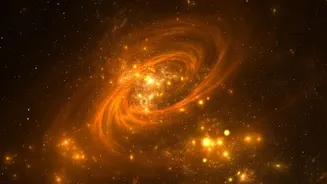
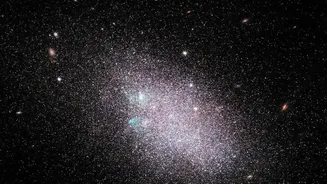
Astronomers believe that about 10 to 11 billion years ago, long before the Earth or sun existed, the young Milky Way was struck head-on by a large dwarf galaxy. This interloper, nicknamed the Gaia-Sausage-Enceladus (GSE), was massive for a dwarf galaxy,
and it plunged directly into our own. The collision was not an instantaneous explosion but a chaotic process that took hundreds of millions of years to unfold. The Milky Way, being the larger of the two, ultimately tore the Gaia-Sausage galaxy to shreds and absorbed its stars, gas, and dark matter. This merger was the single most significant event in our galaxy's early history, fundamentally reshaping its structure.
Reading the Stellar Clues
The evidence for this ancient crash comes from meticulously mapping the stars around us. Using data from the European Space Agency's Gaia satellite, which tracks the positions and movements of billions of stars, astronomers noticed a group of stars moving in a peculiar way. These stars, the remnants of the consumed galaxy, travel on highly elongated, needle-like orbits that look like a sausage in velocity charts—hence the name. Further investigation into the galaxy's vast, sparse stellar halo revealed another mystery. The halo, largely composed of debris from past mergers, rotates incredibly slowly. Scientists wondered why, and powerful supercomputer simulations provided a startling answer.
Flipping the Galactic Disk
Researchers at Durham University ran simulations of galaxy evolution and found a common theme: galaxies with slowly rotating halos, like our own, almost always had two things in common. They had experienced a massive, head-on collision, and their entire disk had flipped by more than 90 degrees as a result. The immense gravitational forces unleashed by the Gaia-Sausage merger would have exerted a powerful torque on the Milky Way's spinning disk of stars and gas. Over a few hundred million years, this torque likely caused the entire disk to slowly but dramatically reorient itself within its larger dark matter halo. In essence, the galaxy we see today is likely tilted on its side compared to its orientation before the collision.
A New Galactic Path
This cosmic flip didn't just change the Milky Way's orientation; it redefined its structure and destiny. The impact and subsequent merger puffed up the galaxy's disk, making it thicker, and scattered debris everywhere, forming the central bulge and the vast stellar halo we see today. The event triggered a firework-like burst of star formation, and may have even contributed to the formation of the Milky Way's central bar structure. Every star in the Milky Way, including our own sun, is now on a different path than it would have been without this defining collision. This new understanding suggests that our galaxy's evolution was not a gentle process but one shaped by violence, destruction, and ultimately, rebirth.