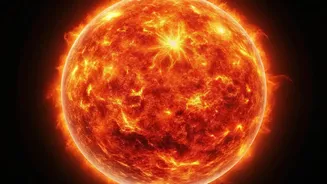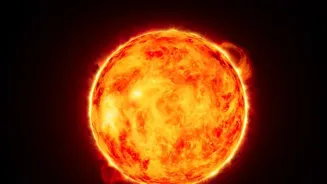





India's Aditya-L1 solar observatory is changing how we see the Sun. A groundbreaking study has revealed that powerful solar eruptions are not the perfect, expanding bubbles scientists once assumed, a discovery with major implications for us on Earth.
India's Eye in the Sky
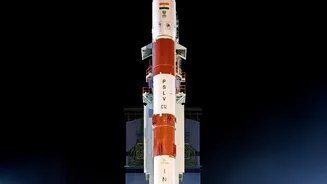
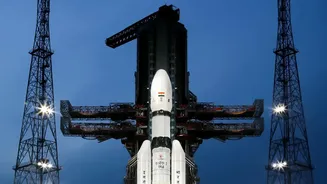
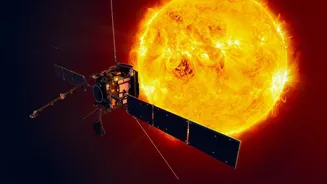
Launched in September 2023, Aditya-L1 is India’s first dedicated space-based mission to study the Sun. It is strategically positioned at Lagrange Point 1 (L1), a gravitationally stable spot about 1.5 million kilometres from Earth. This unique vantage point allows the spacecraft to observe the Sun continuously, without the interruptions of sunrise or sunset that affect Earth-based telescopes. Aditya-L1 is equipped with seven advanced instruments designed to monitor the Sun's outer layers, its magnetic field, and the solar wind. This constant stream of data is fundamental to understanding the star at the centre of our solar system and the powerful phenomena it produces.
What Are Coronal Mass Ejections?
A Coronal Mass Ejection, or CME, is one of the most powerful events in our solar system. It is a massive and violent eruption of plasma and magnetic fields from the Sun's corona, its outermost atmosphere. These eruptions can hurl billions of tonnes of solar material into space at speeds ranging from a few hundred to over two thousand kilometres per second. While many CMEs miss our planet, those directed towards Earth can have significant consequences. They can trigger geomagnetic storms that disrupt Earth's magnetic field, potentially damaging satellites, knocking out power grids, and interfering with GPS and communication signals.
The Symmetrical Bubble Myth
For a long time, scientific models have often simplified CMEs, depicting them as symmetrical bubbles or clouds of plasma that expand uniformly as they travel through space. This assumption made it easier to model their trajectory and predict their potential arrival time at Earth. However, this was largely a simplification because observing the complex, three-dimensional structure of a CME in its early stages near the Sun has always been incredibly difficult. Most instruments could only capture a two-dimensional view of the eruption as it moved across the sky, leaving its true shape and expansion dynamics partially hidden.
A Landmark Observation Changes Everything
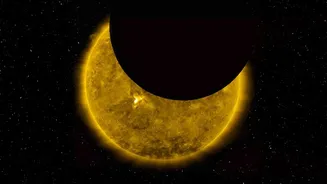
Using its state_of_the_art Visible Emission Line Coronagraph (VELC) instrument, Aditya_L1 has provided a much clearer picture. In a study of a CME that occurred on August 5, 2024, scientists from the Indian Institute of Astrophysics combined data from VELC with images from NASA's Solar Dynamics Observatory. The VELC instrument used spectroscopy to measure shifts in the light from the erupting plasma, a technique that reveals whether the material is moving towards or away from the observer. The data clearly showed the eruption was not expanding evenly. Instead, it was lopsided and had a tilted axis, expanding more on one side than the other. A 3D model confirmed that a symmetrical bubble could not explain the observations; only an asymmetrical model matched the data.
Why Asymmetry Is a Game Changer
Knowing that a CME is not a uniform bubble is more than just a fascinating detail ; it 's a critical piece of information for space weather forecasting. The shape of a CME influences how it travels through the solar wind—the constant stream of particles flowing from the Sun. An asymmetrical eruption will experience different levels of drag, affecting its speed and trajectory in ways that a simple model cannot predict. This could mean the difference between an accurate forecast of a solar storm 's arrival and one that is off by several hours or even misses the mark entirely. This new understanding helps explain the complex magnetic structure within the CME, which is key to predicting how severely it will interact with Earth 's own magnetic field.