

A Digital Canvas 100 Times Bigger
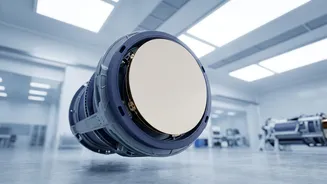
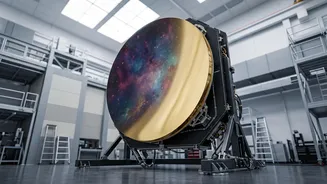
The game-changing feature of the Roman Space Telescope is its Wide Field Instrument (WFI), a 300-megapixel infrared camera that gives it a field of view at least 100 times larger than Hubble’s. While Hubble’s primary mirror is the same 2.4-meter size,
Roman’s optical design is different, allowing it to act like a wide-angle lens with the same sharpness. Think of it as the difference between looking at the sky through a keyhole versus a giant picture window. Where Hubble would need hundreds of individual snapshots to map a section of a galaxy, Roman can do it in just two. This efficiency will allow Roman to survey more than 50 times the amount of sky in its first five years than Hubble has in over 30. It represents a fundamental shift from studying individual cosmic objects in detail to mapping vast celestial ecosystems.
More Than Just Pretty Pictures
These giant images are not just for creating stunning posters; they are data-rich maps designed to tackle some of the biggest questions in astrophysics. Roman’s main goals are to investigate dark energy and discover thousands of exoplanets. By repeatedly imaging the same enormous patches of sky, the telescope will create time-lapse movies of the cosmos, catching the flicker of distant exploding stars (supernovae) and tracking the subtle ways gravity bends light around unseen matter. This technique, known as weak gravitational lensing, helps astronomers map the distribution of dark matter. The sheer volume of galaxies, stars, and planets captured in a single frame provides the statistical power needed to uncover patterns that would be invisible in smaller, more focused surveys.
Hunting for Dark Energy and New Worlds
Roman will attack the mystery of dark energy—the unknown force causing the universe's expansion to accelerate—from multiple angles. By surveying billions of galaxies, it will measure how their distribution has changed over cosmic history, giving clues to whether dark energy’s influence has been constant or has evolved over time. In parallel, its exoplanet survey will be revolutionary. While missions like Kepler stared at one patch of sky, Roman will scan the dense, star-filled central bulge of our Milky Way. It will use a technique called gravitational microlensing, where a foreground star’s gravity briefly magnifies the light of a more distant one, revealing planets orbiting the foreground star. This method is sensitive enough to find planets down to the mass of Mars, potentially discovering thousands of new worlds and providing a true census of planetary systems in our galaxy.
A New Era of Cosmic Data
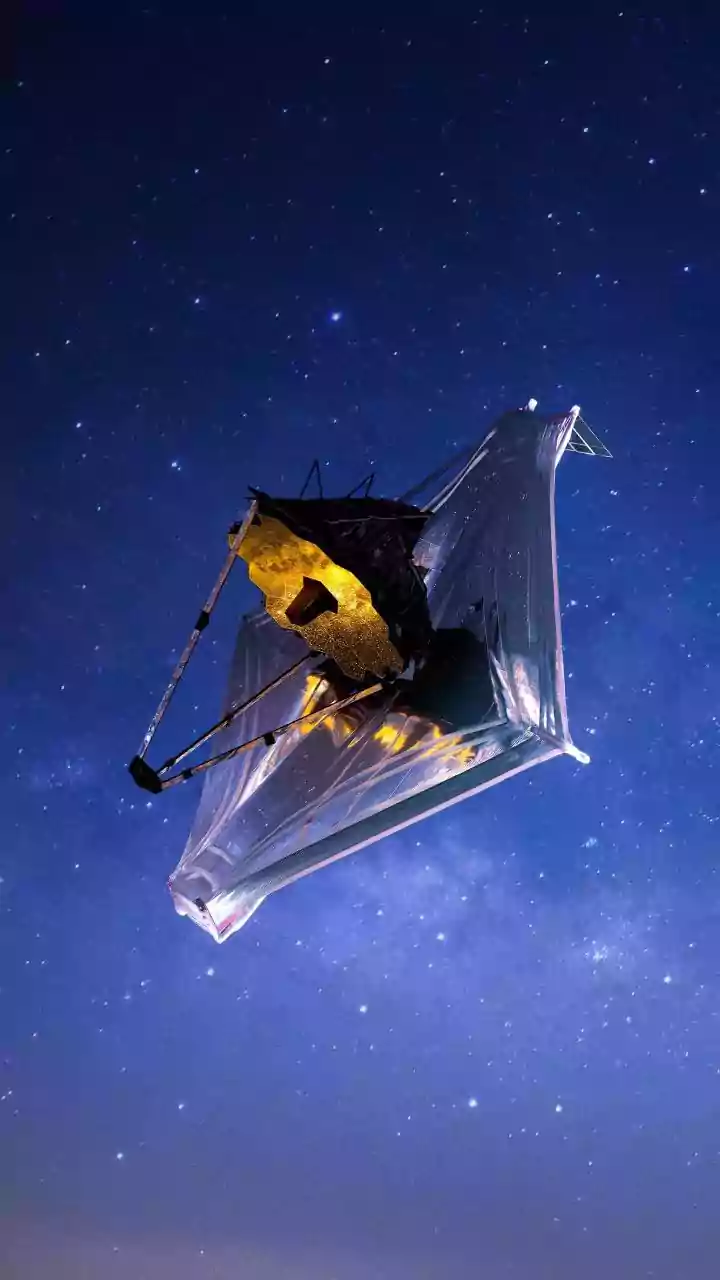
The unprecedented scale of Roman’s imagery also presents a new challenge: data volume. The mission will generate an enormous flood of information that will keep scientists busy for decades. To complement its wide-angle capabilities, Roman also carries a Coronagraph Instrument. This is a technology demonstration designed to block the overwhelming glare from a star, allowing the telescope to directly image large planets orbiting nearby. After its commissioning phase, which will last about three months, the telescope is expected to begin its science operations and produce its first images for the public by early 2027. By pairing its vast surveys with the detailed, targeted observations of telescopes like Hubble and the James Webb Space Telescope, Roman will help guide future exploration, identifying the most interesting targets for its siblings to study in greater detail.