







The next time a light bulb flickers and dies, take a moment before you grab a replacement. The choice between an old-fashioned incandescent bulb and a modern LED is more than just a matter of preference; it's a decision that impacts your wallet and home.
A Tale of Two Technologies
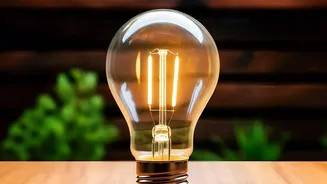
To understand the efficiency gap, we need to look at how each bulb makes light. A traditional incandescent bulb works by heating a tiny wire filament until it glows white-hot. It’s a technology that hasn't changed much in over a century. The problem is that about 90% of the energy it uses is wasted as heat, not light. An LED, or Light Emitting Diode, works very differently. It’s a semiconductor that converts electricity directly into light with very little heat. Think of it as the difference between a campfire and a firefly; one wastes a lot of energy to make a little light, while the other is built for pure illumination.
More Light, Less Energy
The key to understanding bulb efficiency is to stop thinking in watts and start thinking in lumens. Watts measure energy use, while lumens measure brightness. For decades, we associated a 60-watt bulb with a standard level of brightness. That 60-watt incandescent produces about 800 lumens. An LED bulb can produce that same 800 lumens using only 8 to 12 watts of energy. This means LEDs are up to 85% more energy-efficient, converting far more electricity into visible light.
Savings That Add Up
While an LED bulb might have a higher price tag at the store, it is significantly cheaper in the long run. The real cost of a light bulb includes both its purchase price and the electricity it consumes over its lifetime. Because LEDs use so much less energy, the savings on your electricity bill quickly make up for the initial cost. Replacing just one 60-watt incandescent bulb with an LED equivalent can save you a noticeable amount each year. When you multiply that by the dozens of bulbs in a typical home, the annual savings become substantial.
The End of Constant Replacements
Another major advantage for LEDs is their incredible lifespan. A typical incandescent bulb is rated to last for about 1,000 hours. A quality LED bulb, by contrast, can last for 25,000 to 50,000 hours. This means a single LED can outlast 25 or more incandescent bulbs. This longevity not only saves money on replacement bulbs but also saves you the hassle of changing them, which is especially convenient for hard-to-reach fixtures in high ceilings or outdoor spaces.
More Than Just a Money-Saver
The benefits of LEDs extend beyond cost and convenience. Since they produce very little heat, they are cooler to the touch and can reduce fire risk compared to hot incandescent bulbs. They are also more durable, as they don't have a fragile filament that can easily break. Environmentally, the switch is a clear win. Lower energy consumption reduces demand on power plants and cuts down on greenhouse gas emissions. Furthermore, LEDs don't contain mercury, a toxic substance found in compact fluorescent lamps (CFLs), making them a safer and more sustainable choice.
Choosing Your Perfect Glow
Making the switch to LED is easy, but it helps to know what to look for. Check the packaging for lumens to match the brightness you want (around 800 lumens for a 60-watt equivalent). You should also check the 'colour temperature', measured in Kelvin (K). A bulb around 2700K will give off a warm, yellowish light similar to an incandescent, perfect for living rooms and bedrooms. A higher Kelvin number, like 4000K or 5000K, produces a cooler, bluer light that is better for task-oriented areas like kitchens and home offices.