





The Honeycomb Planet
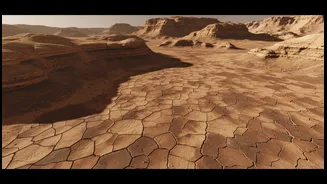
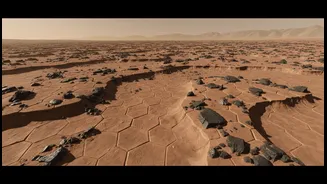
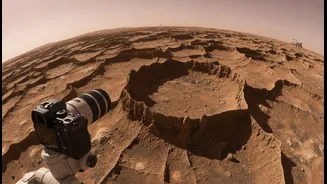
Mars, a planet often defined by its sweeping red plains and towering volcanoes, has a more intricate side. In places like Utopia Planitia and Gale Crater, orbiters and rovers have discovered vast stretches of ground fractured into geometric shapes. These
polygonal patterns, looking like a giant's honeycomb or cracked mud flats, have puzzled scientists for years. First observed from orbit, NASA's Curiosity rover recently got an up-close view, finding a network of irregular, polygon-shaped ridges spread across the rock. The discovery confirmed that these features, which can range from a few meters to tens of meters across, are a widespread and fascinating part of the Martian landscape. Understanding how they form is a key piece of the planetary puzzle.
A Geological Whodunit
On Earth, similar patterns often form in polar regions through the repeated freezing and thawing of ground ice, which causes the soil to expand, contract, and crack over many seasons. Another possibility is the drying of wet sediment, much like cracks that form in a dried-up lakebed. Scientists are exploring whether these same processes were at play on ancient Mars. The presence of these polygons could therefore be a significant clue, hinting at a past where Mars was much wetter and icier than it is today. In fact, some research suggests these patterns were created billions of years ago when the climate at the Martian equator was more like a polar region. But the polygons themselves are only part of the new mystery.
The Dark Rock Question
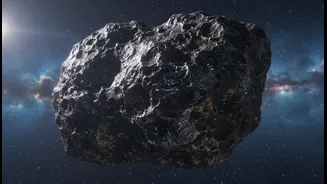
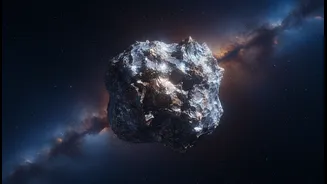
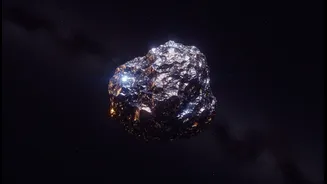
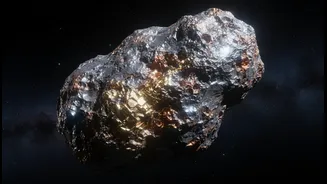
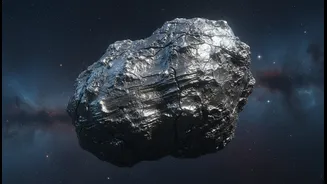
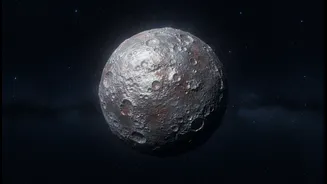
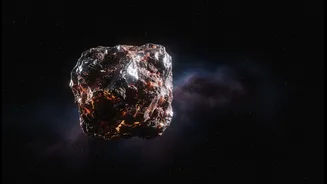
As the Curiosity rover moved closer to these honeycomb structures, scientists noticed something else: the area was littered with dark, pebble-sized rocks. This observation raised a fundamental question. Are these rocks native to Mars, perhaps broken off from higher ground and scattered across the landscape? Or did they come from somewhere else entirely? The thin Martian atmosphere offers little protection from space debris, making it plausible that these dark stones are actually meteorites that have rained down on the planet over eons. The answer could have major implications for our understanding of the local geology and the history of impacts on Mars.
CSI Mars: The Investigation
To solve the mystery, NASA is turning the Curiosity rover into a field geologist. The rover is equipped with a suite of powerful instruments, including the ChemCam, which can fire a laser at a rock from a distance and analyze the resulting vapor to determine its chemical composition. A key element they are looking for is nickel. While not unheard of in Martian rocks, nickel is significantly more common in meteorites. Preliminary analysis of some similar dark rocks found on Mars have indeed revealed the presence of nickel, lending weight to the meteorite hypothesis. By systematically analyzing the composition of these rocks around the polygons, scientists can build a case for or against their extraterrestrial origin.
Why This Mystery Matters
Determining whether these rocks are meteorites isn't just a matter of curiosity. If they are, their distribution and composition can tell us about the history of the Martian atmosphere and how it has changed over time. It provides a record of what has been hitting the planet from the wider solar system. If they are not meteorites, then they are pieces of Mars itself, and their journey to this spot could reveal information about erosion, landslides, or even ancient, explosive volcanic activity. Either way, each rock is a time capsule. This investigation is a prime example of how NASA uses its rovers to do fundamental science, piecing together the history of another world one laser blast at a time.