







Antarctica's Unstable Giant
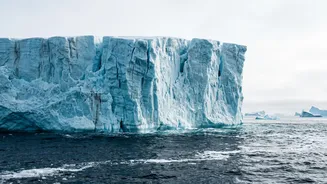
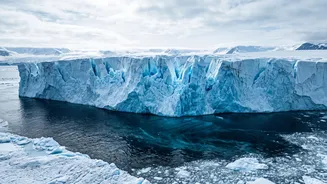
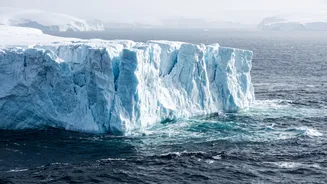
Thwaites is one of the widest and fastest-changing glaciers on Earth, roughly the size of Great Britain or the state of Florida. For decades, scientists have watched with concern as it loses ice at an accelerating rate. Its melting already accounts for
about 4% of annual global sea-level rise. But the real fear is what its collapse could trigger. Thwaites acts like a natural dam, holding back the rest of the vast West Antarctic Ice Sheet. If it were to fail, it could destabilise neighbouring glaciers, leading to a total sea-level rise of around 10 feet, which would redraw coastlines and inundate coastal communities worldwide.
The Hidden Threat: A Weak Underbelly
A glacier's stability depends heavily on its 'grounding line'—the point where the ice stops resting on bedrock and begins to float on the ocean. For a long time, this was thought of as a fixed line. However, recent research shows this is not the case. The boundary is actually a wider 'grounding zone', several kilometres across, where ocean water can push its way inland, especially with the rise and fall of tides. This is where the problem of seawater intrusion begins. Unlike the frigid air temperatures, deep ocean water circulating around Antarctica is relatively warm. This warmer water is the primary driver of the melting that threatens Thwaites from below.
How Seawater Gets In
Using satellite data and underwater vehicles, scientists have confirmed that tides are essentially pumping warm seawater far beneath the grounded ice, sometimes for several kilometres. This intrusion happens through channels and crevasses in the glacier's base. The seawater, being warmer and saltier than the freshwater from the melting ice, attacks the glacier from its most vulnerable point. The process is made worse by the underwater landscape. Much of the land beneath Thwaites has a retrograde slope, meaning it gets deeper further inland. As the warm water melts the ice at the grounding line, the glacier retreats onto ever-deeper ground, exposing even more of its base to the warm ocean currents.
A Vicious Cycle of Melting
This creates a dangerous feedback loop. The more the warm water melts the ice from underneath, the more the grounding line retreats. As the grounding line pulls back, the glacier's flow into the sea speeds up, and even more ice is exposed to the warm water, accelerating the melting further. Recent studies incorporating this process of seawater intrusion into models have produced alarming results. One study suggested that this hidden melting could cause Thwaites to contribute twice as much to sea-level rise by 2100 as previously estimated, even without further climate warming. Researchers found that this pressurised seawater intrusion can induce 'vigorous melt' over many kilometres, making the glacier far more vulnerable to a warming ocean than was previously understood.
From Antarctica to India's Coastline
The fate of a glacier thousands of kilometres away might seem abstract, but its consequences are global. The potential 65-centimetre sea-level rise from Thwaites alone would be catastrophic. Adding the potential collapse of the surrounding ice sheet brings the figure to over three metres. For a country like India with a long, densely populated coastline, the implications are severe. Major cities like Mumbai, Chennai, and Kolkata, as well as vast agricultural deltas, would face existential threats from flooding, erosion, and saltwater contamination of freshwater sources. Understanding the precise mechanisms of seawater intrusion is therefore critical for creating more accurate predictions. This research is essential for policymakers and coastal communities around the world to prepare for the inevitable rise of our oceans.