





The Solar System's Volcanic Heart
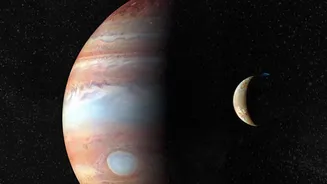
Io is, without exaggeration, the most volcanically active body known to science. With hundreds of active volcanoes, some spewing plumes of sulphur hundreds of kilometres high, its surface is a chaotic canvas of lava flows and colourful deposits. For decades,
scientists have known the cause is a phenomenon called tidal heating. Imagine bending a paperclip back and forth; eventually, the metal heats up from the friction. Io experiences this on a colossal scale. Caught in a gravitational tug-of-war between the immense pull of Jupiter and the rhythmic nudges of its neighbouring moons, Europa and Ganymede, Io’s interior is constantly being squeezed and stretched. This relentless flexing generates an enormous amount of internal heat, keeping the moon geologically active while worlds of similar size, like our own Moon, are cold and quiet.
Peering Beneath the Surface
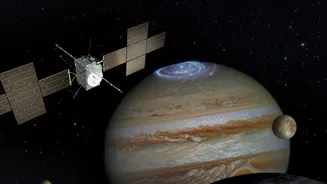
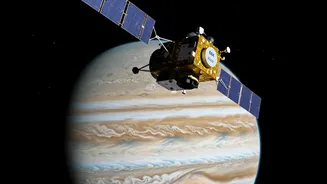
Until recently, our understanding of this heat was literally skin-deep. Scientists relied on infrared instruments that could only measure the temperature of Io's very top surface. That all changed thanks to a clever use of NASA's Juno spacecraft. During close flybys in late 2023 and early 2024, the mission team pointed an instrument called the Microwave Radiometer (MWR) at Io. The MWR was designed to peer through the thick clouds of Jupiter's atmosphere. Scientists realised that this ability could also be used to look several feet beneath the rocky ground of Io, giving humanity its first-ever glimpse of the moon's subsurface temperature profile.
A Subsurface on Fire
The results were stunning. Everywhere the instrument looked, it found temperatures rising sharply just a few feet into the crust. In some places, the temperature climbed by more than 22 degrees Celsius (40 degrees Fahrenheit) over a very short depth. This is a far steeper gradient than could ever be explained by the weak sunlight reaching Io. It is the smoking gun: direct proof of significant heat flowing upwards from the moon's interior, a process that had only been theorised before. The data also offered another surprise, suggesting much of Io is covered in a porous, low-density material—likely layers of volcanic ash and debris from its perpetual eruptions.
Shifting the Geologic Model
These new temperature readings add a crucial piece to a rapidly evolving puzzle. For a long time, the leading theory was that Io’s intense volcanism was fed by a global, subsurface ocean of magma. However, other recent data from the same Juno mission has cast doubt on this idea. Gravitational measurements suggest Io's mantle is mostly solid, not a giant molten sea. The emerging picture is more complex: a world with a partially molten, 'slushy' interior where heat is concentrated in localised pockets rather than a single vast reservoir. The new subsurface heat map helps scientists understand how this energy travels, whether it rises steadily through the crust or escapes from cooling lava flows trapped just below the surface.
A Window into Other Worlds
Understanding the engine that drives Io has implications that ripple across the solar system. Tidal heating isn't unique to Io; it's the same mechanism thought to maintain liquid water oceans beneath the icy shells of other moons, like Europa and Saturn's Enceladus, which are prime candidates in the search for extraterrestrial life. Io serves as a natural, albeit extreme, laboratory for this fundamental process. By studying how tidal forces create the most volcanic body in the solar system, we can better understand how they might create potentially habitable environments elsewhere. The breakthrough even has implications for Earth, offering a new technique that could one day be used to study our own planet's volcanoes.