






An Ocean of Liquid Metal
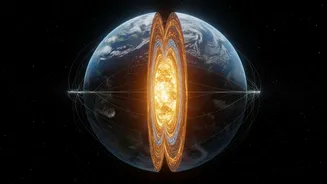
About 2,200 kilometres below the surface lies Earth's outer core, a superheated layer of liquid iron and nickel that swirls around a solid inner core. Think of it as a planet-sized electrical generator. The movement of this electrically conductive liquid creates
the vast magnetic field that shields Earth from harmful solar radiation. For many years, observations of small variations in this field led scientists to believe that the flow within the core was relatively stable, moving mostly westward. However, this long-held assumption was challenged by a surprising event that has reshaped our understanding of the planet's deep interior.
The Great Reversal of 2010
Around 2010, something strange happened deep under the Pacific Ocean. A large section of the molten core, which had been flowing weakly to the west, abruptly changed direction and began surging eastward at a much faster rate. This was a significant and unexpected event. Scientists had previously thought that large-scale changes in the core's flow happened very gradually, over decades or longer. This sudden reversal showed that the core system can be much more dynamic and can change more quickly than anyone realised. The eastward flow continued to strengthen until about 2020, and recent data suggests it may be weakening again, hinting at a complex, cyclical pattern.
Fresh Clues from 'Geomagnetic Jerks'
So how do we know what's happening thousands of kilometres down? The fresh clues come from combining nearly three decades of satellite and ground-based data. Missions from the European Space Agency (ESA) and others have provided high-precision measurements of Earth's magnetic field. Scientists analyse these measurements for rapid changes known as 'geomagnetic jerks'. These are sudden accelerations in the magnetic field believed to originate from turbulent activity deep inside the core. The data revealed that a series of geomagnetic jerks occurred in the years following the 2010 flow reversal, particularly around 2017. This suggests a link between the large-scale flow change and these more abrupt magnetic disturbances, offering a new window into the core's chaotic behaviour.
Why Does This Deep-Earth Drama Matter?
Events happening in the core are not just an academic curiosity; they are fundamental to how our planet works. The magnetic field it generates is vital for life, protecting our atmosphere and technology, like navigation systems and satellites, from destructive solar winds. Understanding these deep flows is crucial for predicting the field's future behaviour. Furthermore, activity in the core is linked to tiny variations in the length of a day. The exchange of momentum between the core and the mantle above it can cause the Earth's rotation to speed up or slow down by milliseconds. In fact, other studies noted a change in the behaviour of the solid inner core around the same 2010-2012 period, suggesting these deep-Earth events may all be interconnected.