




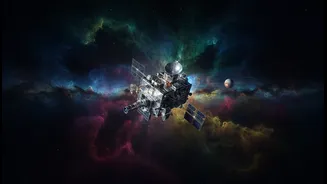


A Wake-Up Call from Deep Space
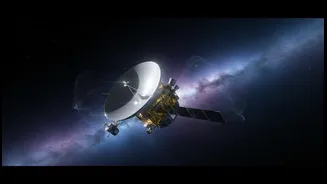
In early July 2026, after a 321-day hibernation to conserve power, NASA’s New Horizons spacecraft re-established contact with Earth. The signal, traveling for nearly nine hours across the vastness of space, confirmed the probe was healthy and ready for its
next assignment. The news sparked excitement among scientists, not just because the plucky probe is still operational after 20 years, but because of what it's doing now. Having completed its primary goals, the mission has evolved. Its new focus is on the boundary that gives the mission its new identity.
From Pluto's Heart to a Space Snowman
New Horizons etched its place in history on July 14, 2015, when it became the first mission to explore Pluto up close. It transformed our view of the dwarf planet from a fuzzy dot into a complex world with vast nitrogen-ice glaciers, towering mountains of water ice, and hints of a subsurface ocean. But the mission team had always planned for a second act. Using the Hubble Space Telescope, they identified a follow-up target while New Horizons was still en route to Pluto. On New Year's Day 2019, the spacecraft executed a flawless flyby of Arrokoth, a primordial object in the Kuiper Belt. The images revealed a bizarre, reddish, double-lobed object often described as a “snowman,” the most distant and primitive body ever explored by a spacecraft. Arrokoth provided a frozen snapshot of the solar system's formation 4.5 billion years ago.
The New Objective: Exploring the Heliosphere
With its flyby targets complete, New Horizons has been repurposed. It is now a unique observatory sailing through the Kuiper Belt, a frigid donut of icy bodies beyond Neptune. Its primary task has shifted from planetary science to heliophysics—the study of the sun and its vast sphere of influence, known as the heliosphere. The spacecraft is now a “boundary mission,” tasked with exploring the frontier where the solar wind, a stream of particles flowing from the sun, collides with the interstellar medium. It is effectively mapping the edge of our solar system's bubble.
A Mission Unlike Any Other
What makes this new phase so critical is that New Horizons carries instruments the legendary Voyager probes did not. While the Voyagers famously crossed into interstellar space, New Horizons' plasma instruments can measure the interaction between the solar wind and interstellar particles in unprecedented detail. Data already shows the solar wind slowing down as it gets further from the sun, loaded with interstellar material it picks up along the way. The spacecraft is also studying the faint glow of the universe, providing unique astronomical data free from the light pollution of the inner solar system. Even while hibernating, its dust counter and particle spectrometers continued gathering invaluable information about this uncharted territory.
A Future on the Frontier
The future for New Horizons is a race against time and distance. NASA has extended its mission through 2029, when it is expected to finally exit the Kuiper Belt. While scientists continue to search for another reachable object for a final flyby, the focus remains on collecting as much data as possible about the heliosphere before the spacecraft’s nuclear power source inevitably fades. For the next few years, it has a precious opportunity to conduct coordinated observations with the Voyager probes, creating a system-wide view of our heliosphere before its predecessors fall silent forever. Its continued operation, once threatened by budget proposals, is a testament to its unique scientific value.