





More Than Just a Walk with Sticks
At first glance, Nordic walking might look like hiking or simply walking with trekking poles, but it's a distinct fitness technique all its own. Originating in Finland as a summer training method for cross-country skiers, the activity uses specially designed
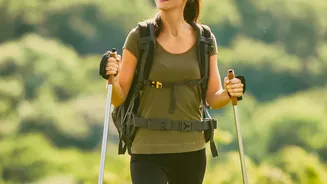
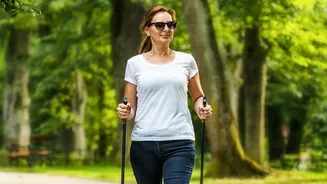
poles to transform walking into a comprehensive, whole-body workout. Unlike hiking poles used primarily for stability on uneven terrain, Nordic poles are used to propel you forward. With every step, you plant a pole behind you and push off, engaging your upper body in a way that regular walking simply doesn't. This rhythmic motion is what elevates it from a lower-body leg day to an exercise that recruits muscles from your shoulders to your core.
A Full-Body Workout Hiding in Plain Sight
The magic of Nordic walking lies in its efficiency. While a standard walk primarily engages the muscles in your lower body, adding poles activates the muscles in your arms, chest, shoulders, and back. Studies show that this simple addition can engage up to 90% of your body's muscles, compared to about 50% with regular walking. The result is a significant boost in calorie expenditure. Research from various institutions, including Harvard Medical School and the Cleveland Clinic, indicates that Nordic walking can burn anywhere from 18% to over 45% more calories than walking at the same pace without poles. This increased muscular engagement also helps improve posture and can release tension in the neck and shoulders.
Intensity Without the High Impact
This is perhaps the most compelling benefit for many people. Nordic walking allows you to significantly increase your cardiovascular effort without the physical toll of high-impact exercises. As you use the poles to push yourself forward, your heart rate increases more than it would during a regular walk. One study found that heart rates were up to 33 beats per minute higher when using poles. Yet, because the poles help distribute the effort across your entire body, the perceived exertion often doesn't feel dramatically harder. You get a better workout—one that improves heart health and endurance—without the pounding stress on your knees, hips, and ankles that is often associated with running. This makes it an ideal activity for people with joint concerns, those recovering from injury, or anyone looking for a sustainable, long-term fitness solution.
Mastering the Poles: A Gradual Journey
The idea of learning a new technique might seem intimidating, but the basics of Nordic walking are straightforward and can be learned progressively. The fundamental movement is coordinating your opposite arm and leg—as your right leg steps forward, your left arm swings forward to plant the pole. The key is to plant the pole at an angle behind you, rather than vertically like a cane. As you move past the pole, you push off, opening your hand on the follow-through to create a smooth, flowing motion. Beginners are encouraged to start slowly, focusing on finding a natural rhythm before worrying about speed or power. You don't need perfect form from day one; the coordination becomes more natural with practice. Many find that taking a lesson from a qualified instructor can help avoid bad habits and accelerate the learning curve.
Getting Started: The Essentials
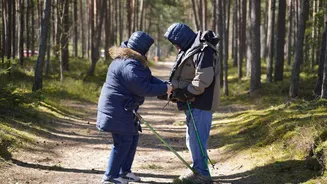
You don't need much to begin your Nordic walking journey, but the right poles are crucial. Look for poles specifically designed for Nordic walking, which feature a glove-like strap system rather than a simple loop. This special strap is essential for the proper "push and release" technique that engages the upper body. Poles come in both fixed-length and adjustable varieties. While adjustable poles offer versatility, fixed-length poles are often lighter and more durable. The right length is important for proper form. Beyond the poles, all you really need is a good pair of comfortable walking shoes and weather-appropriate clothing. Starting with 20- to 30-minute sessions a few times a week is a great way to build confidence and fitness.