




A Ghost Ship's Cargo
Deep beneath the waves near Kekova Island, there is no timber frame or ghostly mast. After 4,700 years, the ship itself has vanished, likely consumed by marine organisms. What remains is its precious cargo, scattered across the rocky seabed about 100
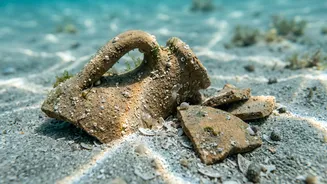
feet down. Archaeologists have meticulously documented more than 30 ceramic jars, known as amphorae, along with three large stone anchors. These remnants are the only surviving evidence of a merchant vessel that was journeying across the Mediterranean when it met its end nearly five millennia ago, during the Early Bronze Age. The discovery, first identified in recent years and excavated in 2026, offers a rare, tangible link to a distant past.
Connecting Dots Across Millennia
The true significance of the Kekova wreck lies in its age and what its cargo reveals about ancient global connections. Researchers dated the wreck to between 4,400 and 4,700 years old, not by radiocarbon dating the absent wood, but by studying the style of the pottery. The design of the amphorae matches others found at major sites across the eastern Mediterranean, including in Egypt, Crete, and Troy. This makes the wreck a contemporary of Egypt's great pyramids, providing physical proof of what was previously only suggested in historical texts: that sophisticated maritime trade was happening at this incredibly early stage of human history. Analysis of the clay shows the jars were likely made in workshops in the Jordan Valley, suggesting the ship sailed from the Levantine coast, perhaps carrying olive oil or wine.
Rewriting Ancient Maritime History
Before this discovery, the title of 'oldest shipwreck' was held by the Dokos wreck, found off the coast of Greece and dated to about 4,200 years ago. The Kekova find pushes that timeline back by several centuries, confirming that organised, long-distance sea travel was not a later innovation but a foundational part of Bronze Age civilisation. This single wreck provides hard evidence that complex trade networks connected distant cultures, moving goods, ideas, and people across the sea. According to Turkish Minister of Culture and Tourism, Mehmet Nuri Ersoy, the find illuminates the 'deep-rooted history of maritime trade' in the region. It demonstrates that nearly 5,000 years ago, the world was already far more interconnected than many had believed.
A Glimpse of Life at Sea
Beyond redrawing trade maps, the wreck offers fascinating clues about the daily lives of ancient mariners. One amphora stands out from the rest; it has two holes in its body and nine distinct marks. Archaeologists have hypothesised that this unique vessel may have been a churn for making butter or cheese. This tantalising possibility suggests that sailors on these long voyages may have brought live goats with them, providing a source of fresh milk that could be processed while at sea. It's a small detail that brings a human dimension to the find, transforming the ancient sailors from abstract figures into resourceful people surviving long and dangerous journeys. This 'time capsule' provides a snapshot of not just what they traded, but how they lived.