


India's Sentinel in Space
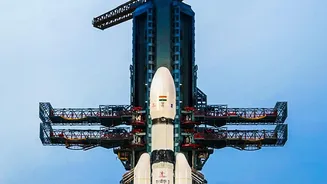
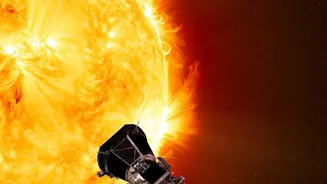
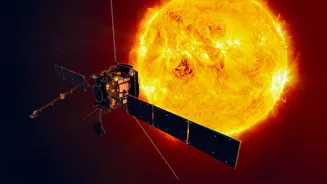
India's first dedicated solar observatory, Aditya-L1, is a testament to the nation's growing prowess in space exploration. Launched by the Indian Space Research Organisation (ISRO), the spacecraft is strategically positioned at Lagrange Point 1 (L1),
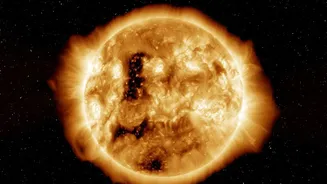
a gravitationally stable spot about 1.5 million kilometres from Earth. This unique vantage point allows for a continuous, uninterrupted view of the Sun. Aditya-L1 is equipped with seven sophisticated instruments designed to study everything from the Sun's outer atmosphere, the corona, to the solar wind that constantly flows outward into space. A key instrument is the Visible Emission Line Coronagraph (VELC), which can observe the solar corona closer to the Sun's edge than many previous missions, capturing the very first moments of solar eruptions.
A European Partner Creates an Eclipse
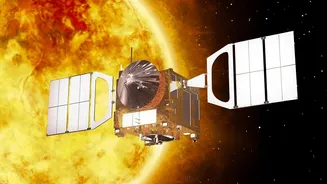
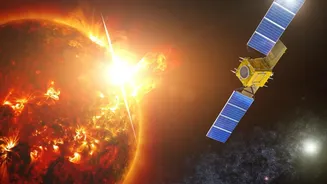
Joining Aditya-L1 in its solar watch is Proba-3, a unique mission from the European Space Agency (ESA). Proba-3 is not one, but two satellites flying in precise formation. One satellite, the 'Occulter', flies about 150 metres ahead of the second satellite, the 'Coronagraph'. The Occulter is designed to cast a precise shadow onto the Coronagraph, creating a man-made solar eclipse that lasts for hours at a time. This innovative technique allows its primary instrument, ASPIICS, to block the Sun's blinding glare and capture incredibly detailed images of the faint, mysterious corona. It’s a technological feat requiring the two spacecraft to maintain their position with millimetre-level precision.
Why Two Perspectives Are Better Than One
The true power of this collaboration lies in combining their different perspectives. Much like how our two eyes give us depth perception, having two spacecraft observe the Sun from different locations provides a three-dimensional view of solar events. This technique, known as stereoscopy, has been used before by missions like NASA's STEREO, which proved the concept's value. Aditya-L1's coronagraph (VELC) makes spectroscopic observations, providing data on the temperature and density of the plasma in an eruption. Meanwhile, Proba-3's coronagraph (ASPIICS) captures sharp, wide-angle images, revealing the shape, speed, and mass of the same event. By combining these two datasets, scientists can build a much more complete, 3D model of a solar eruption than either spacecraft could achieve alone.
Decoding Coronal Mass Ejections
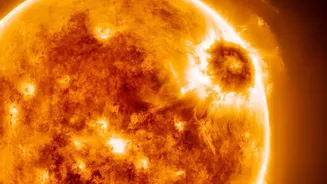
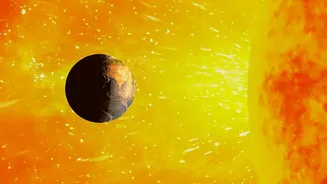
The primary target for this joint observation campaign is Coronal Mass Ejections (CMEs). These are massive explosions that hurl billions of tonnes of plasma and magnetic fields from the Sun into space. When directed at Earth, CMEs can trigger geomagnetic storms that disrupt our power grids, damage satellites, and interfere with communications. Observing their initial moments is crucial for understanding how they accelerate and what makes them dangerous. A recent study, published in 'Astronomy & Astrophysics', detailed the first-ever joint analysis of two CMEs observed by both Aditya-L1 and Proba-3 in September 2025. The combined data allowed scientists to measure the kinetic and thermal energy of the CMEs close to the Sun, a feat that has been historically challenging.
A Landmark India-Europe Collaboration
This scientific partnership is built on a long-standing collaboration between ISRO and ESA. In fact, ISRO's reliable PSLV rocket was used to launch the Proba-3 mission into orbit. For its part, ESA provides ground station support to help track and communicate with Aditya-L1, downlinking the vital data it collects. This synergy demonstrates a new era of international cooperation in space, where sharing resources and data leads to greater scientific returns for everyone. For India, it not only showcases the advanced capabilities of its homegrown instruments like VELC but also cements its position as a key partner in the global effort to understand our star and protect our planet from hazardous space weather.