



The next time you bite into a sweet, jammy fig, consider this: you are not eating a fruit in the way you might think of an apple or a pear. You are, in fact, eating a bouquet of flowers that has blossomed inwards, hiding a secret world.
An Inside-Out Flower Arrangement
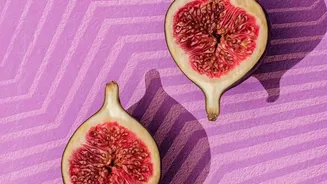
What we call a fig
is not a single fruit, but a complex structure known as a syconium. Essentially, it's a fleshy, hollow stem that has folded in on itself to enclose hundreds of tiny, individual flowers. This is why you never see a fig tree covered in blossoms; its flowers bloom secretly, hidden from the outside world inside these pear-shaped pods. Each of the crunchy little things you might think of as seeds is actually an achene, a tiny fruit containing the real seed, produced by one of the internal flowers. So, when you eat one fig, you are consuming hundreds of fruits and flowers all at once.
A Tragic and Essential Partnership
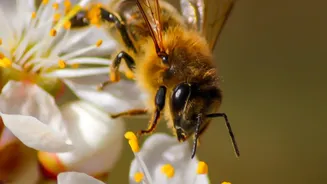
With all the flowers tucked away inside, pollination becomes a challenge. This is where the fig’s obligate partner comes in: the tiny fig wasp. This relationship, which has evolved over millions of years, is a masterpiece of mutual dependence; most of the 850-plus fig species are pollinated by their own unique species of wasp. The process begins when a pregnant female wasp, carrying pollen from the fig she was born in, is attracted by a specific scent to a receptive fig. She enters through a minuscule opening at the bottom called an ostiole. The passage is so tight that she almost always tears off her wings and antennae, making it a one-way trip. Once inside, she begins laying her eggs in some of the tiny flowers while simultaneously pollinating others with the pollen she carried in. Her mission complete, she dies inside the fig.
The Next Generation
Weeks later, the wasp eggs hatch. The male wasps, which are blind and wingless, emerge first. Their sole purpose is to mate with the females, who are still inside their galls, and then chew escape tunnels through the fig's wall for their sisters to use. Having fulfilled their life’s duty without ever leaving the fig, the males die. The newly-hatched, pregnant female wasps then emerge from their flowers. As they leave through the tunnels their brothers created, they pick up pollen from the now-mature male flowers inside the fig. They fly off, carrying both the next generation of wasps and the vital pollen needed to find another fig tree and begin the cycle anew.
So, Are We Eating Wasps?
This incredible story often leads to a pressing question: is there a dead wasp in every fig? The answer is, for the most part, no. Firstly, many of the figs we buy in supermarkets are 'Common' varieties, such as the Brown Turkey or Celeste. These types of figs are parthenocarpic, meaning they can ripen and become sweet and edible without any pollination at all. They produce fruit without the help of wasps, so there is no wasp involved. Secondly, even in the fig varieties that do require pollination, like Smyrna figs, you are not biting into a crunchy wasp. The female wasp that dies inside is tiny to begin with. The fig releases a special enzyme called ficin, a protease that breaks down the wasp’s body, digesting it and absorbing the proteins into the developing fruit. By the time the fig is ripe, any trace of the wasp has been completely recycled by the plant.