
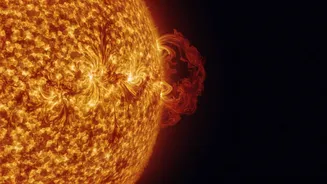

Our Star's Boiling Surface
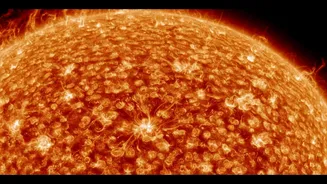
The latest image, captured by the National Science Foundation's Daniel K. Inouye Solar Telescope in Hawaii, shows the Sun’s surface in stunning detail. What looks like golden popcorn or kernels of corn are actually called solar granules. These are vast
cells of churning plasma, each one roughly the size of a large country like France or the state of Texas. This granular pattern is the signature of convection, a process similar to what happens in a pot of boiling water. Hot plasma from the Sun’s interior rises in the bright centers of these cells, spreads out, cools, and then sinks back down in the dark, narrow lanes between them. This entire process is incredibly dynamic, with each granule lasting only about 8 to 20 minutes before being replaced by a new one.
A Technological Marvel
Capturing such an image is a monumental feat of engineering. Looking directly at the Sun concentrates an immense amount of heat and light. The Inouye Solar Telescope, the largest of its kind in the world, uses a massive 4-meter primary mirror to gather light. To prevent the telescope from overheating, it employs a sophisticated cooling system, including a 'heat-stop' and kilometres of piping circulating coolant. This technology allows scientists to resolve features on the Sun's surface as small as 20 to 30 kilometres across for the first time. Although the headline credits NASA, which features the images and collaborates on solar science, the telescope itself is an NSF-led project, representing a major leap for US-led astronomy.
Why These Granules Matter
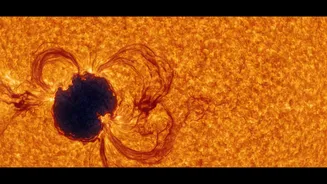
This unprecedented clarity is more than just a pretty picture; it’s a goldmine for scientists. For the first time, researchers can observe the fine, thread-like magnetic structures at the edges of these granules. The Sun’s magnetic field is the engine behind its most violent activity. These new images have revealed swirls and instabilities, never seen in this detail before, at the boundaries where the plasma sinks. Scientists believe these tiny magnetic field markers are key to understanding one of the Sun’s greatest mysteries: why the corona, its outer atmosphere, is millions of degrees hotter than the surface. These small-scale interactions are thought to channel enormous amounts of energy upwards, heating the corona.
Predicting Weather in Space
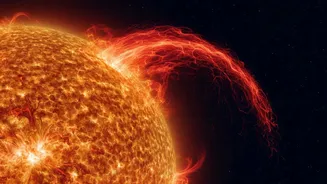
Understanding the Sun's behaviour has very practical implications for us on Earth. The same magnetic energy that heats the corona also powers solar flares and coronal mass ejections (CMEs). When aimed at Earth, these eruptions of charged particles create what is known as 'space weather'. A severe solar storm could disrupt our satellite communications, damage GPS systems, and even bring down power grids. Current space weather forecasting is decades behind terrestrial weather prediction. By studying the fundamental physics of the Sun's surface in such fine detail, scientists hope to build better models to predict when and how these massive eruptions will occur. This new, clearer view is a critical step toward safeguarding our increasingly technology-dependent world.