



Cosmic Nurseries in Decline
Every galaxy is a sprawling city of stars, but like any metropolis, it needs new arrivals to stay vibrant. These arrivals are born in what astronomers call “stellar nurseries”—vast, dense clouds of cold hydrogen gas and dust. Within these molecular clouds,
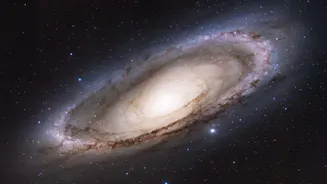
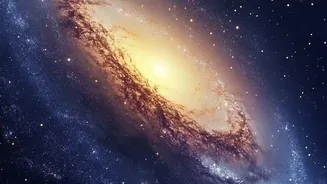
gravity pulls material together, eventually forging brand new stars. For billions of years, the Andromeda galaxy has been a bustling site of star birth, but recent analysis suggests its most fertile regions are entering a long, quiet retirement. A new study based on years of Hubble data shows that star formation in Andromeda has been steadily declining for the last 500 million years, with an even more pronounced drop in the last 40 million.
Reading the Fossil Record of Stars
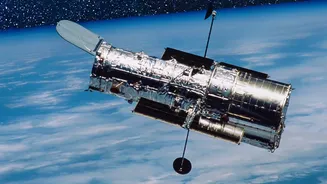
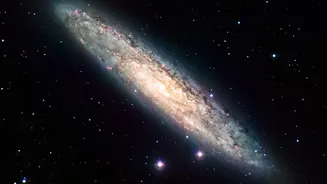
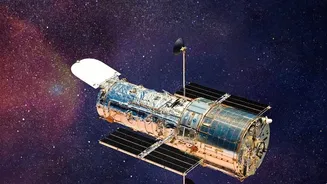
To understand a galaxy's past, you have to read its stars. An international team of astronomers used the Hubble Space Telescope to create an unprecedentedly detailed map of our neighbour. By imaging roughly two-thirds of Andromeda’s disc, they were able to individually measure around 200 million stars. This stellar census acts as a fossil record. Massive stars burn hot, bright, and blue, but they live short lives. Their presence signals recent star birth. Smaller, redder stars live for billions of years, representing an older population. The data showed that Andromeda's star formation rate, which was about one solar mass per year 500 million years ago, has now dwindled to just one-fifth of that.
Why the Slowdown?
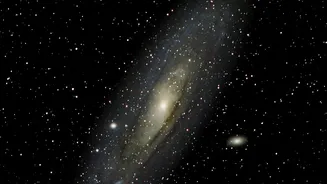
This slowdown isn’t happening uniformly. The research indicates that much of the recent activity has been concentrated in a massive ring of gas and dust about 32,000 light-years from the galactic centre. It is primarily within this ring that star birth is fizzling out. While it might seem like the galaxy is simply running out of fuel, researchers believe it's more of a natural winding-down phase following a more energetic past. About 2 billion years ago, Andromeda experienced a massive burst of star formation, likely triggered by a merger or interaction with another galaxy. One potential culprit is M32, a small satellite galaxy. Data suggests that areas of Andromeda near M32 show a significant drop in star formation beginning around 60 million years ago, making it a 'likely suspect' for having disturbed the gas clouds.
A Glimpse into Our Own Future
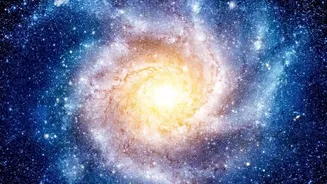
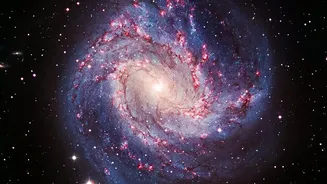
Andromeda's gentle decline into middle age offers a preview of what might be in store for our own galaxy, the Milky Way. While our galaxy is currently more active, producing about 3-5 solar masses worth of stars per year, it too will eventually exhaust its reserves of gas and settle into a more quiescent state. Studying Andromeda, which is located just 2.5 million light-years away, gives us the unique opportunity to examine a galaxy similar to our own in great detail. Its evolution helps astronomers refine their models of how all massive spiral galaxies grow and eventually fade. This transition puts Andromeda in the 'green valley'—a term for galaxies that are moving from the active, star-forming 'blue cloud' to the dormant 'red sequence' of galaxies that have ceased making new stars.
The Coming Collision
The story of Andromeda's future has another dramatic chapter: a colossal collision with our own Milky Way. The two galaxies are hurtling toward each other and are predicted to merge in about 4.5 billion years. This galactic merger, sometimes dubbed 'Milkomeda', won't involve stars crashing into each other due to the immense distances between them. Instead, the two galaxies will pass through one another, their gravitational forces throwing stars into new orbits and triggering a massive new burst of star formation. This event will temporarily reverse Andromeda's decline, using up the remaining gas from both galaxies in a final, brilliant flourish before they settle into a single, giant elliptical galaxy with a much quieter future.