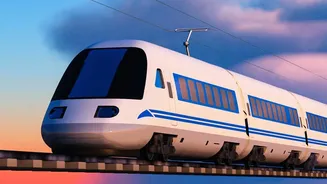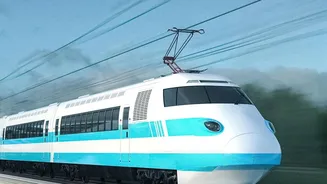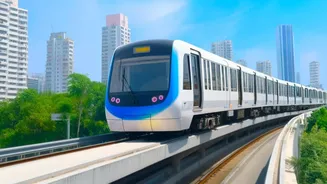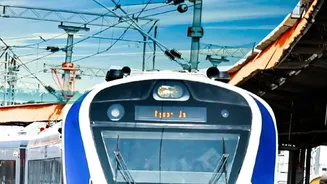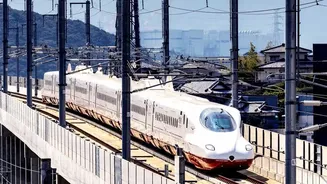




A Project of Speed and Scale
The Mumbai-Ahmedabad High Speed Rail (MAHSR) corridor is one of India's most watched infrastructure ventures. Designed to connect the nation's financial capital with Gujarat's economic hub, the project aims to slash travel time to around two hours. It
is being executed by the National High Speed Rail Corporation Limited (NHSRCL) with significant technical and financial assistance from Japan, utilising its renowned Shinkansen technology. The project, which faced early delays due to land acquisition issues, especially in Maharashtra, and pandemic-related disruptions, is now seeing accelerated progress across Gujarat and Maharashtra. With land acquisition now complete, the focus has shifted entirely to construction, with a target to commence the first service on a portion of the route in 2027.
Rapid Progress in Gujarat
The Gujarat portion of the corridor has been the site of the most visible progress. According to the latest project updates from NHSRCL, a significant part of the civil work in this section is complete. As of late August 2026, pier work and viaduct construction have covered vast stretches of the alignment. Work on stations including Vapi, Bilimora, Surat, and Bharuch is in advanced stages. The plan is to make the Surat-Bilimora section operational by August 2027, which will mark the debut of high-speed rail in the country. This phased approach means that while the entire 508-km line will take longer to complete, Indians will get to experience the bullet train on a functional segment sooner. Track laying, electrification, and the installation of noise barriers are all proceeding simultaneously, turning the concrete viaducts into a ready railway line.
Overcoming Hurdles in Maharashtra
The Maharashtra section, while initially slower, is now catching up. This part of the project involves some of the most complex engineering challenges. A key feature is a 21-km tunnel, which includes India's first undersea rail tunnel running for 7 km under Thane Creek. Construction is also underway on major river bridges over the Ulhas and Vaitarna rivers. Recent reports confirm that significant progress has been made on the 135-km elevated stretch in the state, with pier work crossing the 100-km mark and several mountain tunnel breakthroughs achieved. Work is actively progressing on the three elevated stations at Thane, Virar, and Boisar, with special engineering to protect the local mangrove ecosystem near the Thane station. These milestones are crucial for integrating the entire line and meeting the broader project deadlines.
The 2027 Milestone: What to Expect
Railway Minister Ashwini Vaishnaw has confirmed that trial runs for India's first indigenous bullet train are expected to begin by May or June 2027. These tests will take place on a completed stretch of the Mumbai-Ahmedabad corridor, likely between Surat and Vapi or Surat and Bilimora in Gujarat. The trials are a critical step to ensure the safety and operational readiness of the trains and infrastructure at speeds of up to 320 km/h. It is important to note that the 2027 goal is for the commissioning of the first phase, not the entire Mumbai-to-Ahmedabad route. The full corridor, including the complex underground section in Mumbai, is anticipated to be completed by 2029.