
The Classic Tale of a Cosmic Collision
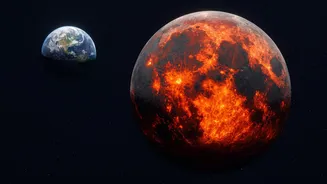
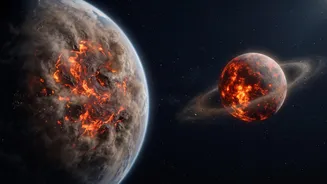
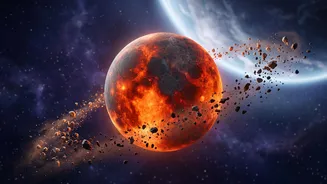
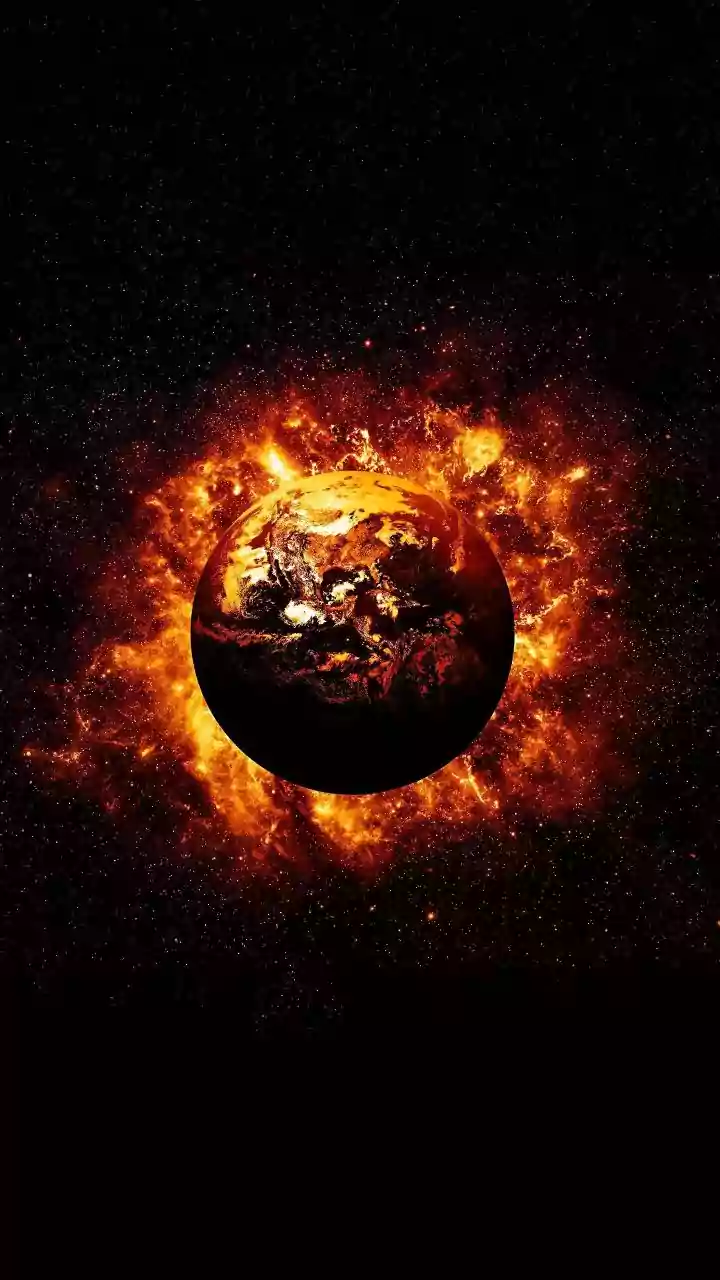
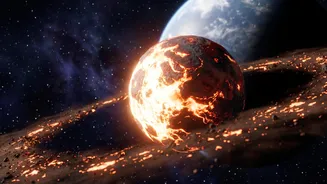
For nearly 50 years, the leading scientific story of the Moon’s origin has been the Giant-Impact Hypothesis. The theory goes that about 4.5 billion years ago, a Mars-sized protoplanet, nicknamed Theia, slammed into a young, molten Earth. This cataclysmic
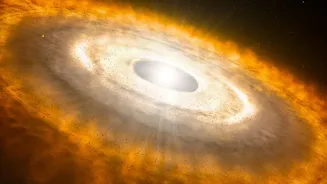
crash wasn’t a direct hit but more of a glancing blow. The impact blasted a massive cloud of rock and debris into orbit around our planet. Over hundreds of thousands, or even millions, of years, this material slowly clumped together, or accreted, eventually forming the Moon we see today. This model explained a lot, such as why the Moon's core is small and why our Earth-Moon system has such high angular momentum compared to other terrestrial planets. It became the textbook explanation for our celestial companion.
A Glaring Hole in the Story
Despite its strengths, the Giant-Impact Hypothesis has a major flaw, often called the “lunar isotopic crisis.” When Apollo astronauts brought back lunar rocks, scientists were stunned to find their isotopic composition was almost identical to rocks on Earth. Isotopes are like atomic signatures, and every planet in the solar system has a unique one. If the Moon was mostly made from Theia’s debris, as the classic model suggests, it should have Theia’s distinct isotopic signature. But it doesn’t; it looks like Earth’s twin. This puzzle has forced scientists to either assume Theia was, by sheer coincidence, identical to Earth (which is highly unlikely) or that the impact was so violent that it completely mixed Earth and Theia’s material, a scenario difficult to model.
A New Challenger: The Five-Hour Moon
This is where powerful new technology changes the game. Using supercomputers, researchers at institutions like NASA and Durham University’s Institute for Computational Cosmology have run some of the highest-resolution simulations of the ancient impact ever created. These models can simulate the collision using hundreds of millions of particles, revealing details that were previously invisible. The results are startling. Instead of a slow accretion from a debris disk, the simulations show it's possible for the impact to have launched a large, self-gravitating clump of material directly into orbit, forming a proto-Moon in a matter of hours. One recent study published in 2026 even proposed a scenario where an intact Moon could emerge in just five hours. This rapid-formation model provides an elegant solution to the isotopic crisis: if the Moon formed immediately from a well-mixed blend of Earth and Theia material, their identical composition makes perfect sense.
What the Evidence Says Now
This “immediate satellite” theory isn't just a computational curiosity; it also better explains some of the Moon’s other strange features. For instance, it could account for the Moon’s tilted orbit and its thin crust, suggesting it may not have been entirely molten after its formation. However, the five-hour formation is a possibility shown in simulations, not a proven fact. The outcome of the impact depends heavily on variables like the collision angle, the speed, and the temperatures of the proto-Earth and Theia. Different simulation parameters produce different results; some still show a debris disk, while others show the rapid birth. The ultimate proof remains locked away in the Moon itself. More recent analyses of Apollo samples suggest that rocks from deeper within the lunar mantle might have a slightly different isotopic signature, potentially a faint trace of Theia.