








A Groundbreaking Vision for India
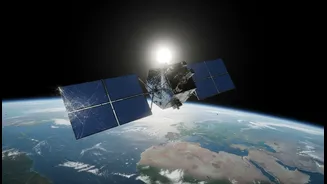
Launched on May 3, 2026, Mission Drishti represented a major leap for India's private space sector. Developed by Bengaluru-based startup GalaxEye, it was the world's first satellite designed to combine two powerful imaging technologies: optical cameras
and Synthetic Aperture Radar (SAR). This hybrid 'OptoSAR' system promised all-weather, day-and-night Earth observation, a game-changer for applications like disaster management, agriculture, and defence surveillance. Weighing around 190 kg, it was the largest privately built Earth observation satellite from India, a testament to the country's growing innovation ecosystem. Hopes were high as the satellite, launched via a SpaceX Falcon 9, began its early orbit phase.
What Went Wrong?
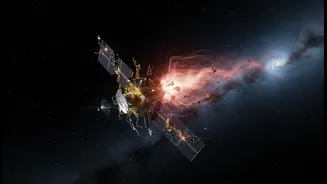
After a successful launch and initial operations where it established contact with ground control, Mission Drishti encountered a severe anomaly. On July 7, 2026, GalaxEye confirmed that the spacecraft had suffered a critical failure following a geomagnetic solar storm. The company stated that initial analysis pointed to radiation effects from this extreme space weather event as the likely cause of the malfunction in a key onboard system. Communication became intermittent before being lost entirely. While recovery efforts were initiated, the company acknowledged that the chances of regaining contact with the satellite appeared low.
The Invisible Enemy: Space Radiation
Space is an incredibly harsh environment, flooded with radiation from several sources. The primary threats to satellites are galactic cosmic rays (energetic particles from outside our solar system), solar particle events (bursts of radiation from the Sun), and particles trapped in Earth's magnetic field, known as the Van Allen belts. When these high-energy particles strike a spacecraft's electronic components, they can cause significant damage. A geomagnetic storm, like the one that hit Mission Drishti, dramatically increases the concentration of these harmful particles, posing a severe threat to orbiting satellites.
How Radiation Disrupts Electronics
Radiation impacts electronics in two main ways. The first is 'Total Ionizing Dose' (TID), which is the cumulative damage from long-term exposure. This gradually degrades a component's performance over its lifespan. The second, and more dramatic, is 'Single Event Effects' (SEEs). An SEE occurs when a single, highly-charged particle strikes a sensitive part of a microchip. This can be non-destructive, causing a temporary glitch like a flipped bit in memory (a 'single-event upset'), which might be fixed with a simple restart. However, it can also be destructive, causing a permanent short circuit (a 'single-event latchup') that can burn out the component and lead to catastrophic system failure. The anomaly aboard Mission Drishti was likely caused by such an effect on a critical system.
A Setback, But Not a Defeat
While the loss of the satellite is a significant setback, GalaxEye has emphasized that the mission was not a total failure. During its brief operational life, Mission Drishti successfully validated critical technologies and the company's ability to design, launch, and operate an advanced spacecraft from its control centre in Bengaluru. The engineering data gathered before the failure is considered invaluable. This experience provides crucial lessons for building more resilient systems in the future. The process of making electronics resistant to space radiation is known as 'radiation hardening', which involves shielding, redundant systems, and using specially designed components. This incident underscores the critical importance of robust radiation hardening for all future missions.