




A Sweet Discovery in a Distant Cloud
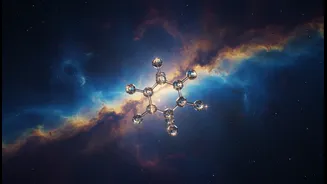
In a finding published in the journal Nature Astronomy, an international team of researchers has detected a four-carbon sugar called erythrulose. They spotted its unique chemical signature in a molecular cloud of gas and dust known as G+0.693−0.027, located
approximately 27,000 light-years from Earth near the heart of the Milky Way. While a simpler, two-carbon 'sugar-like' molecule called glycolaldehyde was detected over two decades ago, this is the first confirmed detection of a more complex, 'true' sugar in the void between stars. The discovery was made using two powerful radio telescopes in Spain that can pick up the faint radio waves emitted by molecules as they rotate in the frigid, near-vacuum of space. Finding erythrulose, a sugar naturally found in raspberries, in such an extreme environment is a landmark moment for astrochemists.
The Building Blocks of Life, Delivered
Sugars are fundamental to life as we know it. They are not just a source of energy; they form the structural backbone of nucleic acids like RNA and DNA, which carry the genetic instructions for all living organisms. For decades, scientists have debated whether these crucial ingredients formed in the primordial soup on early Earth or if they were delivered from space. The discovery of sugars and other organic compounds on asteroids and meteorites has long supported the idea that Earth may have been 'seeded' with prebiotic molecules. Detecting erythrulose in an interstellar cloud—the very nursery where stars and planets are born—takes this theory a giant leap forward. It proves that complex ingredients for life can exist before planets even form, ready to be incorporated into new worlds.
Rewriting the Cosmic Cookbook
Perhaps the most significant part of the discovery is how it upends long-held scientific theories. Established astrochemistry models suggested that complex molecules in space form incrementally, by adding one carbon atom at a time. According to this 'cosmic cookbook,' finding a four-carbon sugar like erythrulose should mean that simpler three-carbon sugars would be even more abundant. But the astronomers found the opposite: erythrulose was plentiful, while three-carbon sugars were nowhere to be seen. This surprising result forced a rethink. The research team now proposes a new formation pathway. They believe erythrulose is created on the icy surfaces of microscopic dust grains when two smaller, two-carbon molecules—glycolaldehyde and ethylene glycol—combine. This suggests that cosmic chemistry may be more complex and varied than previously imagined, with multiple ways to build the molecules of life.
The Search for Our Chemical Origins
This discovery doesn't just solve one mystery; it opens the door to asking bigger questions. Now that scientists know complex sugars can form between stars, the hunt is on for even more significant molecules. The ultimate prize would be detecting ribose, the five-carbon sugar that is the central component of RNA. Finding ribose would provide a direct link to the 'RNA world' hypothesis—the idea that RNA, not DNA, was the original genetic material for the first life on Earth. The detection of erythrulose provides a plausible pathway, as it can be chemically transformed into other useful compounds that are steps on the ladder toward ribose. This makes interstellar clouds like G+0.693−0.027 a prime target for future observations with powerful instruments like the James Webb Space Telescope.