






Beyond the Touchdown
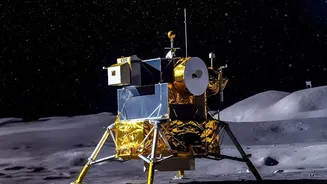
The successful soft landing of the Vikram lander in August 2023 was a moment of immense national pride, cementing India’s position as a global space power. But the mission's true legacy extends far beyond that single achievement. For one lunar day, or about
14 Earth days, the Pragyan rover and Vikram lander conducted a series of groundbreaking experiments. Their primary task was not just to survive, but to perform in-situ science—analysing the lunar environment right where they stood. This approach, analysing materials on-site, has provided an invaluable first look at the makeup and behaviour of the Moon's little-explored south polar region, creating a new playbook for planetary exploration.
Two Ways to Do Science
Space exploration generally relies on two key methods: in-situ analysis and sample-return missions. Sample-return, famously used during the Apollo era, involves bringing physical pieces of another world back to Earth. This allows for incredibly detailed analysis in state-of-the-art terrestrial labs, using equipment far too large and complex to send into space. Scientists can re-examine these samples for decades with new technologies, as was done when water was discovered in Apollo's Moon rocks 40 years after they were collected. In-situ science, on the other hand, is what Chandrayaan-3 excelled at. It involves sending miniaturised laboratories to the destination. Instruments like rovers and landers analyse the soil, rocks, and atmosphere directly on the surface, beaming data back to Earth. While these instruments are less powerful than Earth-based labs, they provide immediate results and, crucially, context.
Chandrayaan-3’s Mobile Lab
The Pragyan rover was equipped with two key instruments for this on-the-spot analysis: the Alpha Particle X-ray Spectrometer (APXS) and the Laser-Induced Breakdown Spectroscope (LIBS). The LIBS instrument fires a high-energy laser at the lunar soil, creating a tiny, superheated plasma. By analysing the light from this plasma, scientists can identify the elements present. This is how Chandrayaan-3 unequivocally confirmed the presence of sulphur near the south pole, along with other elements like aluminum, calcium, iron, and titanium. The APXS provided complementary data, confirming the elemental composition. Meanwhile, instruments on the Vikram lander, like the ChaSTE probe, measured the temperature profile of the lunar topsoil, revealing a surprisingly high surface temperature and unique thermal properties. These were the first-ever in-situ measurements from this region of the Moon.
The Power of Ground Truth
So, how does this on-site data strengthen sample-based science? The answer lies in context. The data from Chandrayaan-3 acts as a detailed map, providing the 'ground truth'. Future missions aiming to bring back samples will have a much better idea of where to land and what to collect. For example, knowing the exact elemental composition and thermal properties of a specific location allows scientists to target areas of high scientific interest, rather than collecting samples blindly. In-situ measurements help scientists understand the diversity and distribution of materials. This ensures that when a costly and complex sample-return mission is launched, it can retrieve the most scientifically valuable materials possible, maximising the return on investment.
A Blueprint for the Future
Chandrayaan-3's success demonstrates that the most effective strategy for space exploration is an integrated one that combines both in-situ analysis and sample return. On-site robotic missions can act as scouts, performing broad surveys and identifying key targets. This approach reduces risk and increases the scientific yield of subsequent, more ambitious missions, including human-led ones. ISRO's findings are not just for India; the data is being made available to international researchers, helping to plan future missions under programs like NASA's Artemis. The mission's demonstration of a 'hop', where the lander reignited its engines and lifted off briefly, also proved a critical capability needed for future sample-return technologies. By providing a rich, contextual dataset from a previously uncharted region, Chandrayaan-3 has not only answered old questions but has also given us a whole new set of smarter questions to ask, and a better way to find the answers.