







The Constant vs. The Unpredictable
At first glance, hiking and stair climbing seem like similar activities. Both are vertical challenges that build serious leg strength and cardiovascular fitness. But the key difference lies in consistency and environment. Stair climbing, whether on a machine
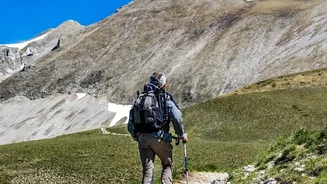
or a staircase, is a controlled, predictable workout. Each step is the same height, the incline is constant, and the surface is even. This makes it an incredibly efficient and accessible way to build strength and endurance. You can easily measure your progress in flights climbed or minutes spent, knowing the intensity is consistent. Hiking, on the other hand, is beautifully unpredictable. A trail's gradient changes constantly, the terrain can be rocky or smooth, and external factors like weather and the weight of your pack add layers of difficulty. This dynamism provides a more holistic workout, engaging smaller stabiliser muscles and improving balance and coordination in ways a staircase cannot.
Decoding Trail Elevation
The term that truly defines a hike's intensity is 'elevation gain'. This isn't just the difference between the highest and lowest points of a trail. Instead, cumulative elevation gain is the sum of every single uphill section you climb. For example, a trail might start at 500 feet, climb to 800 (a 300-foot gain), dip down to 700, and then climb again to 1,000 feet (another 300-foot gain). Even though the net change from start to finish is only 500 feet, your total elevation gain is 600 feet. This number is what tells you how much work your body is actually doing against gravity. Apps and trail websites like AllTrails provide this crucial metric, which is a far better indicator of a hike's difficulty than mileage alone. A short, 3-mile hike with 2,000 feet of gain can be much more strenuous than a flat 8-mile walk.
Muscles Worked and Calories Burned
Both activities are powerhouses for your lower body, targeting the glutes, quadriceps, hamstrings, and calves. Because you are lifting your bodyweight with every step, the strength benefits are significant. Stair climbing provides a focused, high-intensity burn that is hard to beat for efficiency. Hiking engages these same primary muscles but adds the core and various stabiliser muscles in your hips and ankles, which work overtime to keep you balanced on uneven ground. When it comes to burning calories, the intensity of stair climbing often results in a higher burn per minute. However, hikes are typically much longer in duration. A vigorous hour of stair climbing might burn between 600 and 700 calories for a 70kg person, while a steep mountain hike could burn 500 to 650 calories per hour, but can be sustained for a full day, leading to a much larger total expenditure.
Understanding Intensity with METs
To get a more scientific comparison, we can look at Metabolic Equivalents (METs). One MET is the amount of energy you use while sitting at rest. Activities are assigned MET values based on their intensity. For example, walking slowly is about 2.0 METs, while brisk walking is around 4.3 METs. Climbing stairs is considered a vigorous activity, clocking in at around 4.0 METs for a slow pace and up to 9.0 METs on a stair machine. Hiking is generally rated around 6.0 METs for cross-country trekking, but can rise to 7.5 METs or higher when climbing hills with a pack. This shows that while both can be high-intensity, a vigorous stair session can push your energy expenditure higher in a shorter amount of time.
The Perfect Partnership
Instead of seeing it as a competition, it's best to view hiking and stair climbing as complementary activities. Living in a flat area? Regular stair training is one of the most effective ways to prepare your legs and lungs for a mountain adventure. It builds the specific strength in your quads and glutes needed to power up hills, making those climbs feel much more manageable when you do hit the trail. It's a targeted tool for building hiking-specific fitness. However, no amount of gym time can fully replicate the specific demands of a trail. Descending, navigating tricky footing, and carrying a pack all require practice in a real-world environment. Use the stairs to build your engine and strength, then take that fitness to the trails to refine your balance, endurance, and trail-smarts.