








Meet the Habitable Worlds Observatory
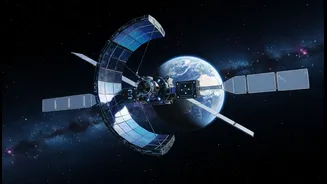
The next great eye on the cosmos will be the Habitable Worlds Observatory (HWO). Recommended by the National Academies as the highest-priority astrophysics mission for the coming decades, HWO is being designed to be the first telescope with the specific
goal of finding signs of life on planets outside our solar system. Slated for a potential launch in the 2040s, this flagship mission will build on the legacies of the Hubble, James Webb (JWST), and Nancy Grace Roman space telescopes. It will operate in the ultraviolet, optical, and infrared light spectrums, giving it a versatile toolkit for cosmic discovery. Its primary target will be to directly image at least 25 Earth-like planets and analyze them in detail, a feat that requires unprecedented technological leaps.
How to Look for Life From a Million Miles Away
Searching for life doesn't mean looking for little green men. Instead, HWO will hunt for biosignatures—chemical clues in a planet's atmosphere that hint at biological processes. The observatory will be equipped with an advanced coronagraph, a tool designed to block the overwhelming glare of a host star, allowing the faint light of a nearby planet to be seen. By capturing this planetary light, HWO can use spectroscopy to spread it into a rainbow, revealing the chemical composition of the planet's atmosphere. The goal is to detect gases like oxygen, methane, and ozone, which on Earth are telltale signs of life. To achieve this, the telescope needs incredible stability, with components that can't move more than a fraction of a hydrogen atom's diameter during observations.
A Telescope Built to Evolve
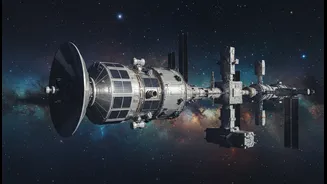
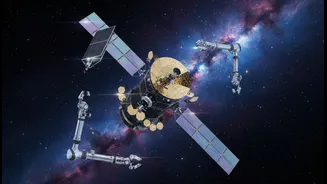
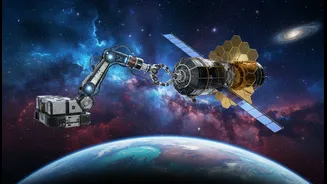
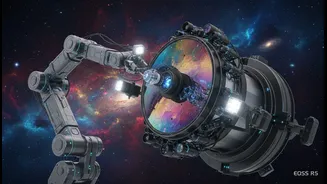
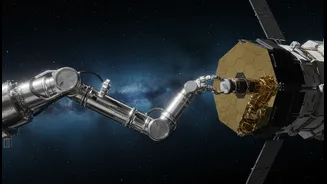
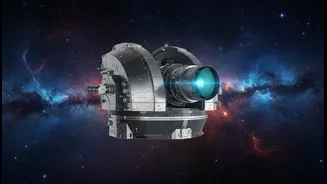
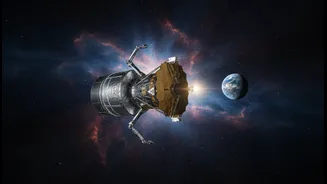
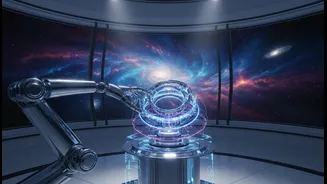
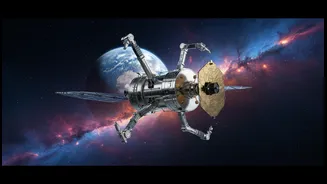
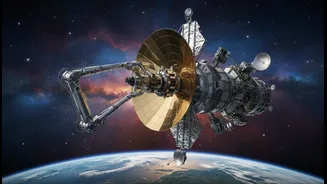
Perhaps the most groundbreaking aspect of the Habitable Worlds Observatory is its design philosophy. Unlike the James Webb Space Telescope, which was a one-shot deployment, HWO is being designed from the ground up for robotic servicing, assembly, and maintenance. This is a crucial lesson learned from Hubble, whose life was extended for decades by astronaut servicing missions. However, HWO will be positioned about 1.5 million kilometers from Earth at a location called Lagrange Point 2 (L2), far beyond the reach of human crews. The solution is to make the observatory modular, with key components designed as standardized, swappable units that robotic spacecraft can replace. This means that worn-out parts can be fixed and, more importantly, new, more advanced instruments can be installed years after launch.
The Future of Sustainable Space Exploration
This modular, robotic-friendly architecture marks a major strategic shift for NASA. It transforms an $11 billion observatory from a static asset into an upgradable platform. If scientists develop a revolutionary new sensor or camera a decade after HWO's launch, a robotic mission could be sent to install it. This extends the observatory's scientific lifetime and ensures it can adapt to new discoveries and technological breakthroughs without the massive expense of building an entirely new telescope. NASA envisions a future where commercial companies could provide these robotic servicing missions, creating a new ecosystem for maintaining our most critical assets in space. This approach not only maximizes the return on a massive public investment but also paves the way for even more ambitious projects, such as telescopes so large they must be assembled in orbit by robots.