





A Fading Whisper From The Void
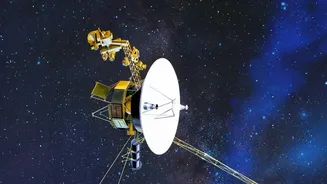
Launched in 1977, the twin spacecraft Voyager 1 and Voyager 2 represent one of humanity’s greatest exploration achievements. They completed a “Grand Tour” of the outer planets, revolutionizing our understanding of Jupiter, Saturn, Uranus, and Neptune.
But their mission didn't end there. They kept going, eventually crossing the heliopause—the boundary where the Sun’s influence gives way to the vast expanse between the stars. Today, Voyager 1 is the most distant human-made object, billions of kilometres from home. Yet, these remarkable machines continue to send back data from a region no other probe has ever reached. This incredible longevity is thanks to a unique power source, but that power is, by its very nature, finite and fading.
The Nuclear Heartbeat of Deep Space
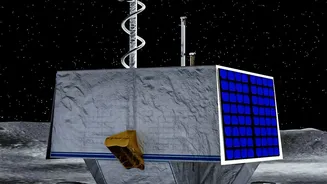
To survive for decades in the cold, dark outer solar system where sunlight is too faint for solar panels, the Voyager probes rely on Radioisotope Thermoelectric Generators, or RTGs. Think of an RTG as a nuclear battery. It contains pellets of Plutonium-238, a radioactive material that naturally generates a significant amount of heat as it decays. This heat is captured by devices called thermocouples, which convert the temperature difference into a steady flow of electricity. With no moving parts, RTGs are incredibly reliable and long-lasting, making them perfect for missions that need to operate for decades without any chance of maintenance. At launch, the Voyagers' RTGs provided about 470 watts of power—enough to run a few household light bulbs, but sufficient to power the spacecraft's computers, radio transmitter, and scientific instruments.
An Unstoppable, Predictable Decline
The weakening of the generator is not a failure, but an expected consequence of physics. The Plutonium-238 that powers the RTGs has a half-life of about 87.7 years. This means that every year, the amount of heat produced by the plutonium decreases slightly as more of its atoms decay. This translates to an annual power loss of about 4 watts for each spacecraft. For nearly 50 years, this slow, predictable decline has been tracked by mission engineers at NASA's Jet Propulsion Laboratory (JPL). Now, the power margins have become razor-thin, forcing the team to make difficult choices to keep the mission alive.
Keeping the Mission Alive
To conserve every last watt, JPL engineers have become masters of extreme energy efficiency. Over the years, they have been systematically shutting down non-essential systems, such as instrument heaters and entire scientific instruments, to prolong the lives of the most critical components. Each spacecraft launched with 10 instruments, but many have been turned off as power levels dropped. Recently, engineers devised a clever strategy for Voyager 2 that involved shutting down a specific piece of hardware and using lower-power alternatives, a move that is expected to keep its remaining three science instruments running for at least another year. Similar power-saving measures are planned for Voyager 1. These efforts are a delicate balancing act to ensure the spacecraft can still collect unique data from interstellar space, point its antenna toward Earth, and transmit its faint signal across the cosmos.
The Final, Silent Chapter
NASA hopes to keep receiving data from at least one instrument on each Voyager probe until around 2030. Eventually, however, a time will come when there isn't enough power to run even the most basic systems. The communication link will be the last thing to go. When the transmitter can no longer be powered, the probes will fall silent forever. But their journey will not end. They will continue to travel at tens of thousands of kilometres per hour, coasting silently through the Milky Way galaxy for thousands, or even millions, of years. They will become silent ambassadors, carrying with them the Golden Record—a time capsule of sounds, images, and music from Earth, waiting for a far-off, future encounter. The end of the Voyager mission won't be an explosion or a crash, but a quiet disconnection, marking the end of an era of discovery.