




Listening to a Silent Planet
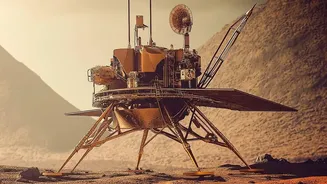
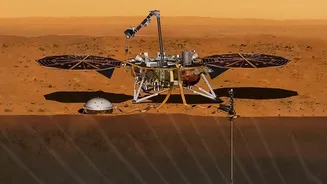
Before NASA's InSight lander touched down in 2018, our knowledge of Mars' interior was largely theoretical. Rovers and orbiters gave us stunning views of the surface, but what lay beneath was a mystery. InSight's primary mission was to change that. By
placing a highly sensitive seismometer on the Martian surface, scientists could finally listen for “marsquakes.” These tremors, caused by everything from internal stresses to meteorite impacts, send seismic waves traveling through the planet. By studying how these waves changed speed and shape, scientists could finally begin to map the crust, mantle, and core of Mars, much like a doctor uses an ultrasound to see inside a patient.
A More Complicated Past
The prevailing view was that Mars, lacking Earth's dynamic plate tectonics, had a relatively simple volcanic history. Scientists imagined isolated volcanoes fed by simple magma chambers. But the InSight data, particularly from recent analyses published in journals like Nature Astronomy, has painted a dramatically different picture. A new study identified a distinct boundary about 24 kilometers (15 miles) below the surface. Researchers believe this layer marks where ancient magma once accumulated and evolved, suggesting the planet hosted vast, interconnected magma systems that stretched for hundreds, possibly thousands, of miles.
Rethinking Planetary Plumbing
This discovery of a complex, Earth-like underground plumbing system is a game-changer. On our planet, this kind of transcrustal magmatism is linked to the formation of continents and the recycling of materials, processes driven by plate tectonics. Finding evidence of a similarly sophisticated structure on Mars — a planet without plate tectonics — forces a major rethink. It suggests that rocky planets can develop chemically complex crusts through different pathways than previously believed. This newly revealed complexity points to a Mars that was far more dynamic than the 'stagnant lid' planet scientists had categorized it as.
Implications for a Once-Habitable World
A more complex volcanic system has profound implications. Such large-scale geological activity could have played a crucial role in shaping the planet's early environment. Extensive volcanism releases gases that form an atmosphere, and the heat from vast underground magma networks could have driven hydrothermal systems, creating conditions potentially favorable for life to emerge. While this discovery doesn't prove life existed on Mars, it suggests the necessary ingredients and conditions for habitability might be more common on rocky planets than we thought, even on those without the unique geological engine of plate tectonics.
The Lasting Legacy of InSight
Although the InSight mission officially ended in December 2022 after dust covered its solar panels, the scientific mission is far from over. The lander detected over 1,300 marsquakes, including a monster magnitude 5 event, providing a treasure trove of data that scientists will be analyzing for years to come. These new findings about Mars' volcanic past are a powerful demonstration of the lander's success. It was sent to take the planet's vital signs and, in doing so, has revealed a world with a far more intricate and dynamic inner life than anyone had suspected.