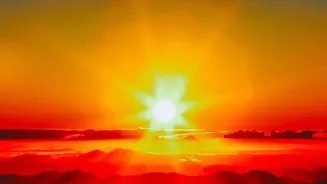



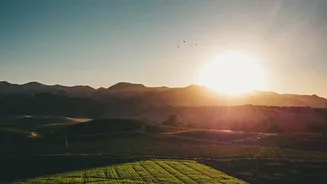
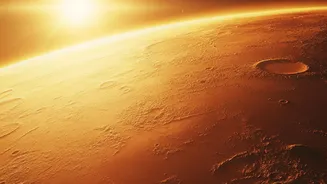
It’s a sight that stops us in our tracks: a brilliant sunset painting the horizon in fiery shades of red and orange. This daily spectacle is more than just beautiful—it’s a fascinating display of physics playing out on a grand scale.
The Colours Within Sunlight
First, it helps to
remember that the sunlight that looks white or yellow to us is actually a combination of all the colours of the rainbow. Just like a prism can split white light into a spectrum, the Earth’s atmosphere does something similar, but in a less organised way. Each colour travels as a wave of energy, with some colours having shorter wavelengths (like blue and violet) and others having much longer ones (like red and orange). This difference in wavelength is the key to understanding why the sky changes colour throughout the day.
Our Atmosphere as a Filter
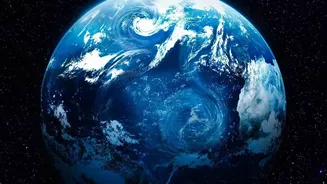
Think of Earth’s atmosphere as a giant, invisible filter filled with countless tiny gas molecules, mostly nitrogen and oxygen. When sunlight enters the atmosphere, it doesn't just pass through cleanly; it collides with these molecules. This interaction causes the light to scatter, or bounce off in different directions. The way this light scatters is not random; it depends heavily on the light's wavelength. This phenomenon is known as Rayleigh scattering, named after the physicist who first explained it.
Why the Daytime Sky Is Blue
The secret to both blue skies and red sunsets is the same: Rayleigh scattering. Blue light, with its short wavelength, is the perfect size to be scattered very effectively by the tiny gas molecules in the air. During the middle of the day, when the sun is high overhead, this blue light gets scattered all across the sky. So when you look up, you’re seeing this bounced, scattered blue light coming at you from every direction, making the sky appear blue. The other colours, like red and orange, are less affected and pass through more directly.
The Long Road at Sunset
Everything changes when the sun gets low on the horizon, at either sunrise or sunset. At this angle, the sunlight has to travel through a much thicker slice of the atmosphere to reach your eyes. It’s a longer, more challenging journey. Because the light is passing through so much more air, there are many more opportunities for it to interact with gas molecules. This longer path is the critical element that transforms a blue sky into a red one.
Red Is What Remains
On this extended journey, the short-wavelength blue and violet light is scattered away so completely that very little of it makes it directly to your eyes. It’s bounced out of the direct beam of sunlight long before it reaches you. What's left are the longer-wavelength colours: the yellows, oranges, and reds. These colours are not scattered as easily and can push through the thick atmosphere more or less in a straight line to your eyes. The result is that the sun itself, and the clouds it illuminates, appear in these warm, fiery tones. The red isn't being 'created'; it's what survives the atmospheric obstacle course.
Dust and Clouds Add Drama
While gas molecules are the primary actors, other particles in the air can make sunsets even more dramatic. Dust, smoke, and pollution can enhance the scattering effect, often leading to more intense reds and oranges. That’s why sunsets can look particularly stunning after a volcanic eruption or on days with a bit of haze. High- and mid-level clouds also act like a movie screen, catching the last red rays of the setting sun and reflecting them down, creating a truly spectacular and colourful display that can fill the entire sky.