
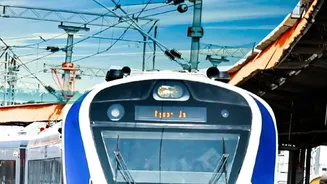
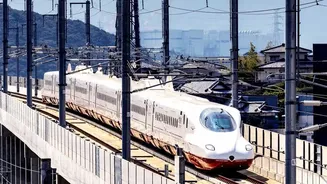

The 2027 Trial Run: What to Expect
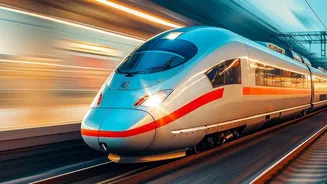
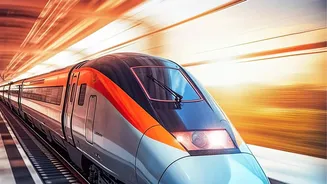
Union Railway Minister Ashwini Vaishnaw has confirmed that India's first indigenous high-speed train will begin testing on the tracks by May or June 2027. This crucial testing phase is expected to last between two and four months, after which the first commercial
service could be inaugurated. The initial trials will not cover the entire 508-kilometre route. Instead, they will focus on a segment in Gujarat where construction is most advanced, specifically the stretch between Surat and Bilimora. These trials are essential for validating the performance and safety of the trains, tracks, and signalling systems under operational conditions before they are opened to the public. The first body frame of the indigenously manufactured train has already been completed and sent for squeeze testing to verify its structural integrity.
Progress Report: A Tale of Two States
The overall progress of the Mumbai-Ahmedabad corridor has been a story of two different paces. In Gujarat, work has moved swiftly, with a significant portion of the civil construction, including viaducts and bridges over rivers, nearing completion. Officials have stated that the Surat-Vapi section is expected to be completed by December of this year. In contrast, progress in Maharashtra has faced more hurdles, primarily related to land acquisition and obtaining necessary clearances, which caused initial delays. However, work is now in full swing in Maharashtra as well, including the construction of three elevated stations at Thane, Virar, and Boisar, and the complex 21-km undersea tunnel near Thane. This phased approach means the line will likely open in sections rather than all at once.
The Full Journey: From Trial to Terminus
While the first service is targeted for 2027 on a limited section, the entire Mumbai to Ahmedabad corridor is projected to be fully functional by 2029. The phased rollout will likely see the Surat-Bilimora section open first, followed by extensions to Vapi and eventually Ahmedabad. The final leg connecting to Mumbai is the most complex, involving the country's first undersea rail tunnel. Once fully operational, the high-speed service will dramatically cut travel time. The journey between Mumbai and Ahmedabad, which currently takes over six hours by train, is expected to be completed in just under two hours with limited stops. The corridor will feature 12 stations in total, including a multimodal hub at Sabarmati that will connect the bullet train with local metro, bus, and railway networks.
More Than Just Speed
The project is about more than just fast travel; it represents a significant leap in India's infrastructure and manufacturing capabilities. The trains themselves are being developed indigenously as part of the 'Atmanirbhar Bharat' initiative, designed to operate in India's specific climate conditions of heat and dust. The National High Speed Rail Corporation Limited (NHSRCL) is already planning for the future, looking into developing next-generation trains capable of speeds up to 350 kmph for all future high-speed corridors. The project is also a massive training ground, transferring world-class Shinkansen technology and engineering skills to Indian professionals, which will be invaluable for the planned expansion of the high-speed rail network across the country.