


A Planet’s Protective Shield
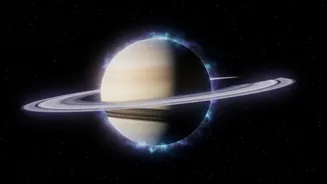
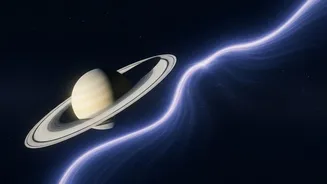
Think of a magnetosphere as a planet’s invisible force field. Generated deep within a planet's core, this magnetic bubble extends far into space, shielding the planet from the harsh solar wind—a constant stream of charged particles flowing from the Sun.
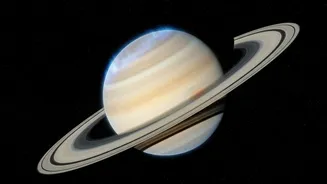
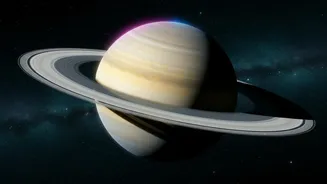
Earth has one, which protects our atmosphere and makes life possible. Jupiter has the most powerful one in the solar system. Saturn’s, however, has always been a bit of an oddball, presenting a puzzle that has intrigued scientists for decades.
The Saturn Anomaly
Most planets, including Earth, have a magnetic field that is tilted relative to their spin axis. This tilt is believed to be crucial for generating and sustaining the field. But Saturn’s magnetic axis is almost perfectly aligned with its rotational axis, a feature that defies conventional theories of how planetary magnetic fields work. This perfect alignment also makes it incredibly difficult for scientists to measure the true length of a day on Saturn, as they often rely on the wobble of a tilted magnetic field to calculate a planet's core rotation rate.
Cassini’s Lingering Ghost
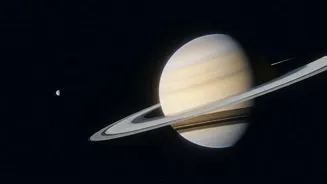
Enter the Cassini spacecraft. A joint mission of NASA, the European Space Agency (ESA), and the Italian Space Agency (ASI), Cassini orbited Saturn for 13 years, from 2004 to 2017, gathering an unprecedented amount of data. Though the spacecraft plunged into Saturn's atmosphere at the end of its mission, the treasure trove of information it sent back is still being analysed, leading to fresh discoveries years later. A recent study, published just this month, takes a new look at Cassini's observations to finally explain the distortion at the heart of Saturn's magnetic shield.
A Lopsided Bubble Explained
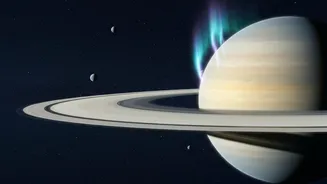
The new analysis reveals that Saturn's magnetosphere is not symmetrical like Earth’s. Instead, it is significantly lopsided. Researchers found that a key feature called the magnetic cusp—a funnel-like opening near the poles where solar particles can enter the atmosphere—is not located at the 'noon' position (facing the sun), as it is on Earth. On Saturn, it's consistently dragged toward the 'afternoon' side. This distortion is caused by two powerful forces acting in concert: Saturn's incredibly fast rotation (a day is only about 10.7 hours long) and a dense cloud of plasma supplied by its geologically active moon, Enceladus.
Rotation and a Watery Moon
Enceladus is famous for the giant plumes of water vapour that erupt from a subsurface ocean. This material becomes ionised—forming a plasma—and feeds into Saturn’s magnetosphere. The planet’s rapid spin then drags this heavy soup of plasma around with it, effectively overpowering the influence of the solar wind and pulling the entire magnetic structure sideways. This confirms a long-held theory: on giant, fast-spinning planets, internal dynamics can be more important in shaping the magnetosphere than external forces from the Sun. The distortion isn't a flaw; it's a fundamental feature of how planets like Saturn operate.
The Bigger Question Answered
So, what was the big space-science question? It was about which force reigns supreme in the environments of giant planets. While Earth's magnetosphere is largely shaped by the external pressure of the solar wind, this new analysis confirms Saturn's is dominated by its own internal rotation and plasma loading. Understanding this fundamental difference not only solves a key mystery about Saturn but also provides a model for what we might expect at Jupiter and even giant exoplanets orbiting other stars. It also has practical implications for future missions, like a proposed return to Enceladus, by helping to map the complex electromagnetic environment they will have to navigate.