





A Tale of Two Blazars
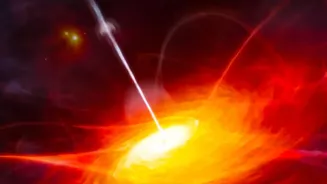
To understand a microblazar, you first have to meet its much bigger cousin: the blazar. At the heart of some distant galaxies, supermassive black holes millions of times heavier than our sun gorge on gas and stars. This feeding frenzy is messy, and some of the material
is shot out from the black hole’s poles in colossal jets of plasma that travel at nearly the speed of light. When one of these jets happens to be aimed directly at Earth, the object shines with incredible intensity across the electromagnetic spectrum. That’s a blazar. For over 30 years, scientists have theorized that a smaller version should exist within our own galaxy. A microblazar follows the same principle but on a stellar scale: a smaller black hole, just a few times the mass of the sun, performing the same light-speed trick.
Introducing the Candidate
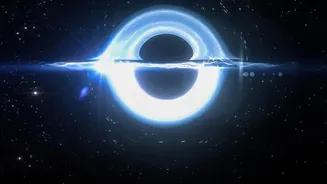
IRAS 18293-0941 is a binary system, meaning two objects are locked in a gravitational dance. In this case, it’s a black hole about ten times the mass of our sun and a huge, hot companion star. They orbit each other every 11 days. Like a cosmic thief, the black hole’s immense gravity strips material away from its stellar partner. This stolen gas forms a swirling, superheated disk around the black hole before falling in. But not all of it meets that fate. A portion is channelled by powerful magnetic fields and blasted into space as two opposing jets. The object was first spotted by the Infrared Astronomical Satellite back in 1983 but was mostly forgotten, its true nature concealed by thick interstellar dust that made it invisible to optical telescopes.
The Telltale Evidence
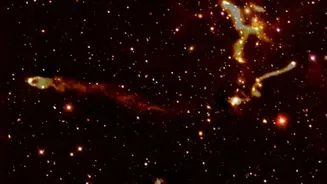
What makes astronomers so confident that IRAS 18293-0941 is a microblazar is its jet. Using a network of radio telescopes, including the European VLBI Network and the MeerKAT array in South Africa, scientists got a remarkably clear view. They saw something peculiar: a jet extending from only one side of the black hole. This is a classic sign of 'relativistic beaming'. Because the jet is pointed almost perfectly at us and moving at around 75% of the speed of light, its radiation is dramatically amplified, making it appear incredibly bright. The second jet, aimed away from Earth, is consequently so faint that it becomes invisible. This one-sided appearance is the smoking gun for an object whose cosmic firehose is aimed our way.
A Galactic Laboratory
Finding a microblazar candidate in our own galaxy is a monumental discovery. Actual blazars are so far away that their central engines are just single points of light even to our best telescopes. IRAS 18293-0941, being relatively close, offers an unparalleled natural laboratory to study the physics of how black holes launch these powerful jets. Furthermore, this system could help solve another major cosmic mystery: the origin of the most energetic particles in the Milky Way. As the jet from IRAS 18293-0941 travels through space, it slams into clouds of interstellar gas. This collision is believed to create a powerful particle accelerator, one capable of producing energies 100 times greater than what can be achieved at the Large Hadron Collider on Earth. This makes the system a prime suspect for being a 'PeVatron', a source of ultra-high-energy cosmic rays that bombard our planet.