

A Galaxy Knocked Sideways
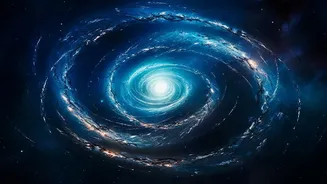
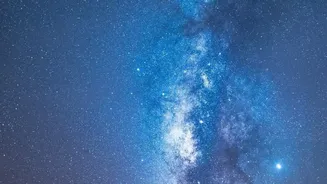
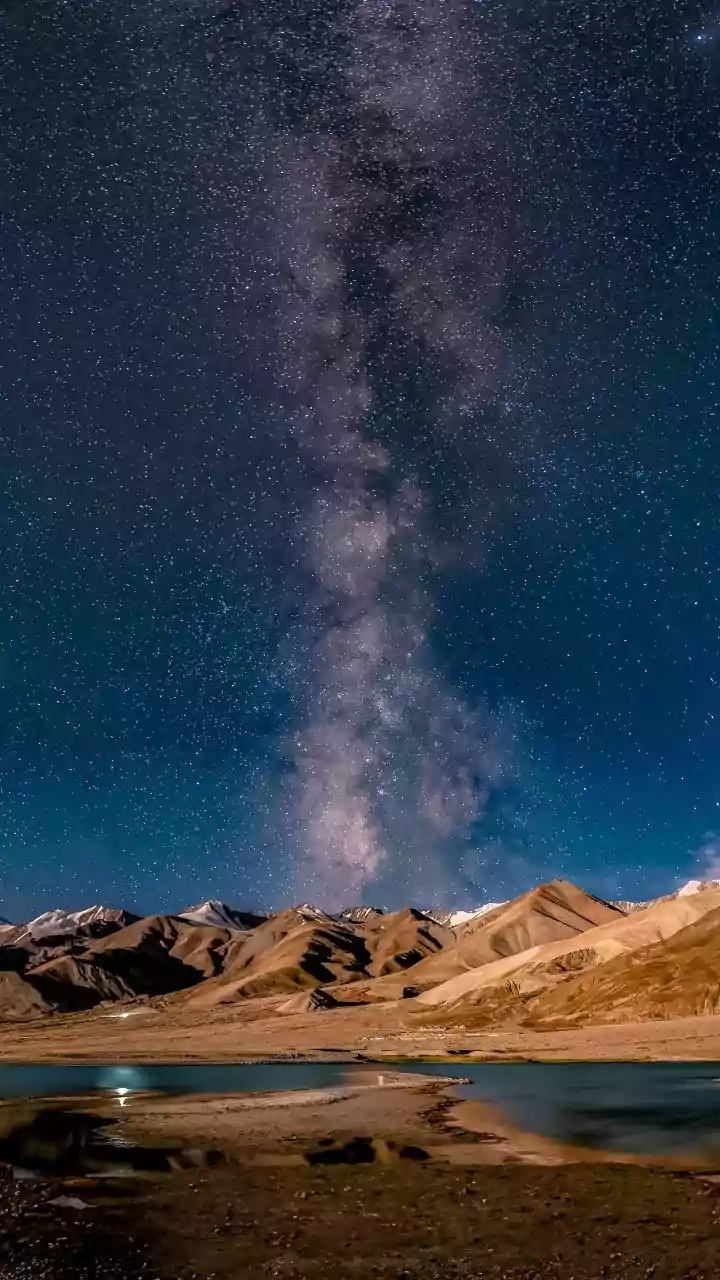
When we picture the Milky Way, we imagine a vast, flat, spinning disk. For the most part, that’s accurate. But astronomers have known for decades that the picture isn't perfect. The outer edges of our galactic disk are distorted in what is known as a galactic warp,
with one side curving up and the other down, like the brim of a fedora. Now, a new study suggests this isn't just a minor tweak. Researchers from Durham University say a head-on collision with a smaller galaxy long before our solar system was born likely caused the entire Milky Way disk to flip by more than 90 degrees. This 'sideways turn' was not an instantaneous event but a gradual reorientation that likely took hundreds of millions of years to complete.
The Prime Suspect: Gaia Sausage
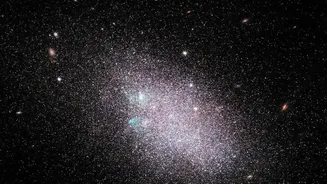
The culprit behind this cosmic upheaval is believed to be a dwarf galaxy known to astronomers as the Gaia-Sausage-Enceladus, or simply the Gaia Sausage. This name comes from the sausage-like shape of the orbits of its former stars, which were discovered in 2018 using data from the European Space Agency's (ESA) Gaia mission. About 10 billion years ago, this smaller galaxy, which still contained billions of suns' worth of stars, gas, and dark matter, smashed directly into the early Milky Way. Our larger galaxy tore the interloper to shreds and absorbed its stars, but the gravitational chaos unleashed by the impact was enough to exert a powerful torque, slowly tipping our entire galaxy over.
Clues Hidden in the Stars
The evidence for this ancient flip came from trying to solve a different puzzle: the strangely slow rotation of stars in the Milky Way's halo. The halo is a vast, sparse sphere of stars surrounding the main galactic disk. Data from the Gaia satellite, which is meticulously mapping the positions and motions of billions of stars, showed that while stars in the disk orbit the galactic center at a brisk 220 kilometres per second, those in the halo poke along at just 25 kilometres per second. To figure out why, the Durham University team ran powerful supercomputer simulations. They found that Milky Way-like galaxies that experienced a head-on collision followed by a 'disk flip' consistently ended up with slow-moving stellar halos, just like the one observed in our own galaxy.
A New Chapter in Our Galactic Story
This discovery reshapes our understanding of the Milky Way's evolution. The collision with the Gaia Sausage is considered the last major merger in our galaxy's history and a defining event that shaped its central bulge and populated its stellar halo. Finding that this event also flipped the entire disk adds a dramatic new chapter to that story. It implies that the tranquil river of stars we see in the night sky is the result of a violent and chaotic youth. According to researchers, this means that most of the Milky Way's stars, possibly including our own Sun, once moved on very different paths than they do today. Our 'stable' spot in the galaxy might not have been so stable for the solar system's entire existence.