



India's Sentry at Lagrange Point 1
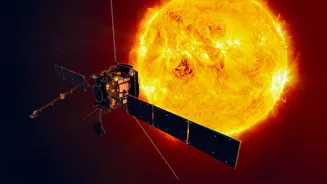
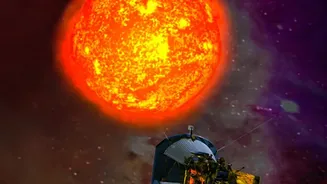
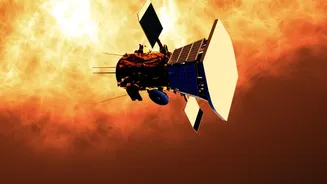
At the heart of this international effort is ISRO's Aditya-L1, India's first dedicated solar observatory. Launched on September 2, 2023, it maintains a constant watch over the Sun from its strategic perch at the first Sun-Earth Lagrange point (L1), about
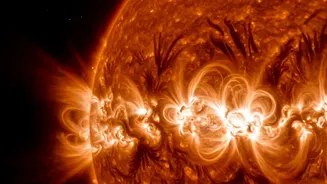
1.5 million kilometres from Earth. This unique vantage point allows for an uninterrupted view of our star, free from the eclipses or occultations that would occur in an Earth orbit. A key instrument aboard Aditya-L1 is the Visible Emission Line Coronagraph (VELC), developed by the Indian Institute of Astrophysics (IIA). VELC is designed to study the Sun's outer atmosphere, the corona, by analysing its light spectrum. This allows scientists to measure crucial properties like the temperature, density, and velocity of the coronal plasma, providing vital clues about the origins of solar phenomena.
Europe's Artificial Eclipse in Space
The other half of this dynamic duo is the ESA's Proba-3, a mission that is itself a marvel of engineering. Notably launched by ISRO's own PSLV-XL rocket, Proba-3 isn't a single spacecraft but two, flying in precise formation. One spacecraft, the 'Occulter', flies about 150 metres ahead of the other, the 'Coronagraph'. This exact alignment allows the Occulter to block the blinding glare of the Sun's main disk, casting a perfect shadow over the Coronagraph. The result is a man-made, on-demand solar eclipse that can last for hours. This provides the ASPIICS instrument on the Coronagraph spacecraft with an unprecedentedly clear view of the Sun's faint inner corona, a region notoriously difficult to observe.
A Breakthrough in Teamwork
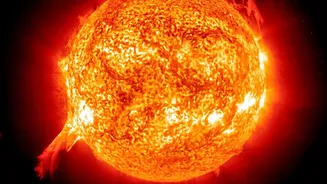
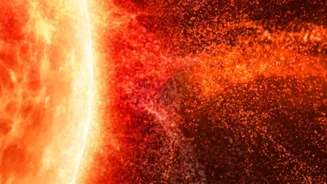
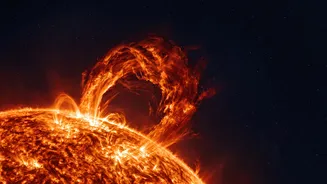
The real magic happens when data from these two distinct missions are combined. A recent study, published in the journal 'Astronomy & Astrophysics', details how researchers from the IIA in Bengaluru and international partners jointly analysed two Coronal Mass Ejections (CMEs) that occurred in September 2025. These massive eruptions of plasma and magnetic fields from the Sun are a primary driver of space weather, which can disrupt satellites and communication networks on Earth. While Proba-3's ASPIICS provided sharp images of the CMEs' shape and mass, Aditya-L1's VELC provided spectroscopic data on the temperature and density of the superheated gas within them. This allowed scientists, for the first time, to cross-check their measurements and build a more complete, three-dimensional picture of the eruptions' initial moments.
New Clues to Solar Violence
The joint analysis of the two CMEs from September 14 and 16, 2025, revealed stark differences in their behaviour. One eruption travelled at a blistering 645 km per second, while the other was much slower, at 145 km per second. The study showed how the energy in these events was distributed between kinetic (motion), thermal (heat), and magnetic energy. For instance, in the faster CME, thermal energy was a tiny fraction of the total, whereas in the slower one, thermal energy grew to match the kinetic energy as it evolved. According to an ISRO statement, these findings provide new constraints on the physical processes that shape CMEs in their infancy, a critical step towards better understanding and predicting their journey through space.
A Model for Future Collaboration
This successful joint study does more than just advance solar science; it highlights the growing synergy between space agencies and the immense value of coordinated multi-spacecraft observations. The fact that ISRO not only launched its own world-class solar observatory but also provided the launch vehicle for its European counterpart's mission is a powerful statement of India's capabilities and its role as a reliable partner in global space exploration. By combining their unique instruments, Aditya-L1 and Proba-3 have demonstrated a model for future missions, proving that observing complex systems like the Sun from multiple perspectives yields insights far greater than the sum of their parts. This approach paves the way for a new era of collaborative space science.