


A Landmark Partnership in Solar Science
For the first time, scientists have combined data from India's pioneering Aditya-L1 mission and the European Space Agency's (ESA) innovative Proba-3 mission to study the same solar events. This joint effort, involving researchers at the Indian Institute
of Astrophysics (IIA) in Bengaluru and their international partners, is providing a uniquely comprehensive view of powerful eruptions known as coronal mass ejections (CMEs). By merging observations from two state-of-the-art spacecraft, the team has been able to measure the mass, density, and energy of these massive plasma bursts nearer to the Sun's surface than ever before, a feat that was previously challenging for single-mission observations. The findings represent a significant leap forward in our quest to understand the Sun and predict its often-disruptive behaviour.
Meet the Solar Sentinels
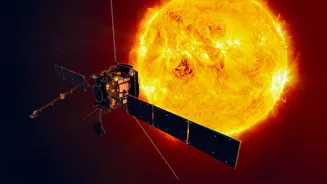
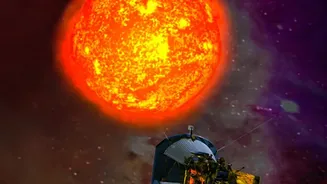
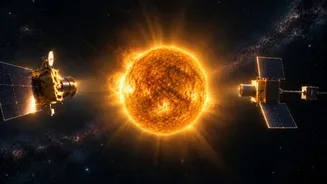
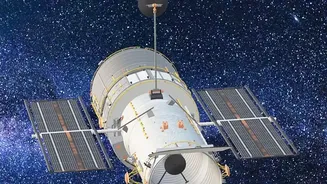
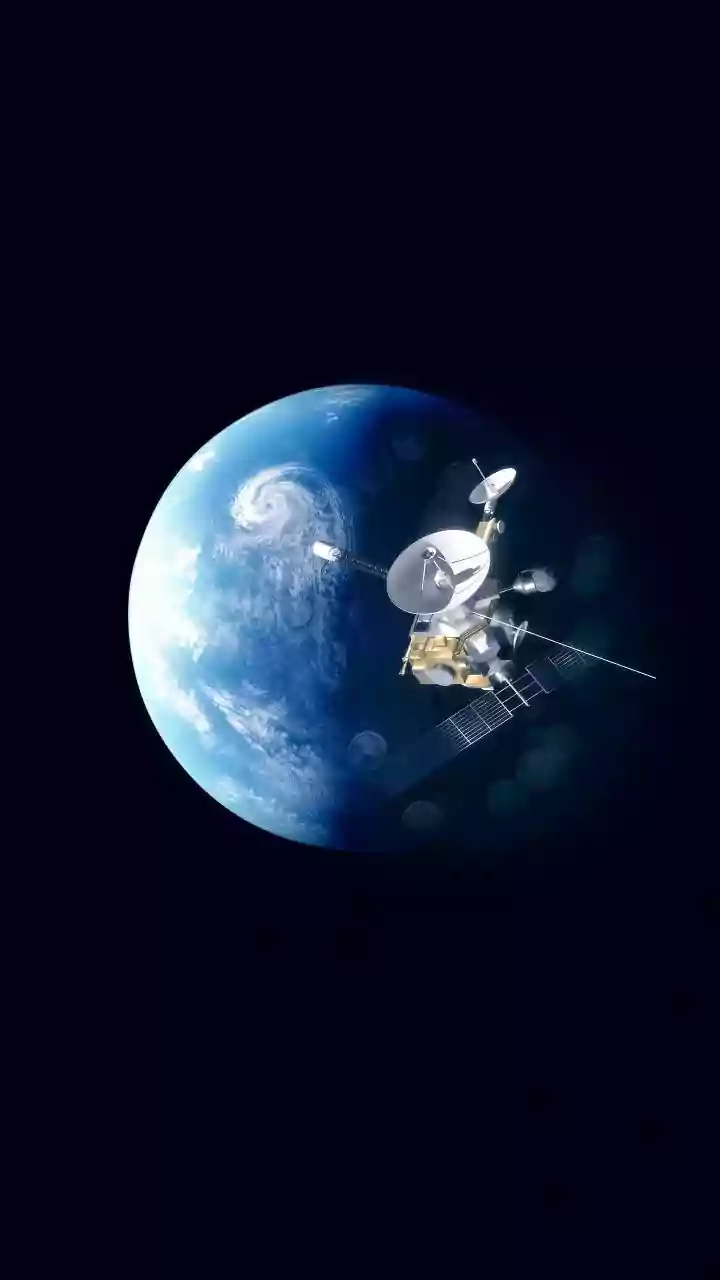
The success of this collaboration lies in the complementary capabilities of the two missions. India's Aditya-L1, launched by ISRO in September 2023, is the nation's first dedicated solar observatory. Positioned at the strategic Lagrange Point 1 (L1), it enjoys an uninterrupted view of the Sun. Its key instrument in this study is the Visible Emission Line Coronagraph (VELC), which performs spectroscopy on the Sun's corona—its superheated outer atmosphere—to analyse the properties of the plasma.\n\nESA's Proba-3, launched by an ISRO PSLV rocket in December 2024, is a marvel of engineering and the world's first precision formation-flying mission. It consists of two satellites flying in a precise alignment about 150 metres apart. One spacecraft acts as an 'occulter', casting a precise shadow onto the other, which carries the coronagraph. This creates a near-perfect artificial solar eclipse in space, allowing its ASPIICS instrument to capture incredibly clear images of the faint, inner corona, which is normally washed out by the Sun's intense glare.
Decoding the Sun’s Fiery Eruptions
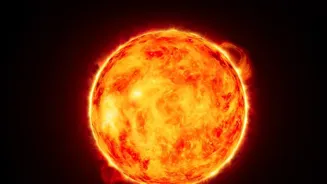
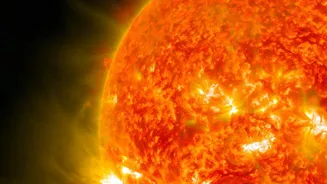
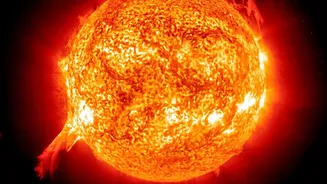
Coronal Mass Ejections are colossal explosions that hurl billions of tonnes of magnetised plasma from the Sun into space at immense speeds. Understanding where and how they originate is crucial, but observing their birth has always been difficult. Previous coronagraphs struggled to see the very early stages of these events close to the solar disk. This left a gap in our knowledge about how their energy is distributed and how they evolve. The Aditya-L1 and Proba-3 partnership changes that. VELC's spectroscopic data reveals the temperature and density of the plasma, while ASPIICS provides sharp images of the CME's structure and movement. Together, they create a multi-dimensional picture, allowing scientists to track CMEs from their infancy and build more accurate models of their behaviour.
Why This Research Matters for Earth
While the Sun sustains life, its violent outbursts pose a direct threat to our technologically dependent world. When a CME is aimed at Earth, it can trigger severe 'space weather'. These solar storms can disrupt our planet's magnetic field, damage critical satellites used for communication and GPS, endanger astronauts, and even cause widespread power outages by overwhelming electrical grids. The better we can understand the physics of CMEs close to their source, the better we can forecast their trajectory and potential impact. This India-Europe collaboration is a crucial step towards developing more reliable space weather prediction models, giving us more time to protect our vital infrastructure both in space and on the ground.