



A Sweet Signal from Deep Space
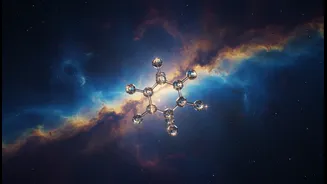
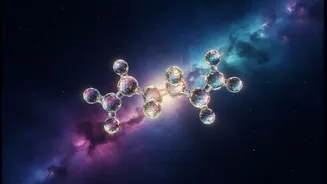
In a remarkable first, an international team of astronomers has detected a true sugar molecule floating in a molecular cloud near the center of our Milky Way galaxy. The molecule, erythrulose, is a four-carbon sugar that, here on Earth, is found in raspberries
and is even used in some self-tanning products. While scientists have previously found sugars inside meteorites that have landed on our planet, this is the first time a sugar has been identified directly in the interstellar gas from which stars and planets form. The discovery was made in a dense cloud of gas and dust named G+0.693-0.027, located approximately 27,000 light-years away. This cloud is known as a rich chemical reservoir, a sort of cosmic pantry stocked with complex molecules. Finding erythrulose here supports a tantalizing theory: that the fundamental building blocks of life don’t have to be made on a planet, but can instead form in the harsh environment of space and be delivered to young worlds by comets or asteroids.
How to Spot a Sugar 27,000 Light-Years Away
Detecting a specific molecule across such an immense distance is a monumental feat of cosmic detective work. The team, led by researchers at Spain's Center for Astrobiology, used the powerful Yebes 40-meter and IRAM 30-meter radio telescopes. These instruments don't see light in the way our eyes do; instead, they listen for radio waves. Every molecule, from simple water to complex sugars, vibrates and rotates in a unique way, emitting or absorbing energy at very specific frequencies. This creates a one-of-a-kind spectral "fingerprint." By scanning the G+0.693-0.027 cloud and comparing the signals to laboratory measurements of erythrulose, the astronomers found 12 clean matches. It was the chemical equivalent of hearing a faint, but distinct, melody from across the galaxy and knowing exactly which instrument was playing it. The strength of this signal confirmed not just the sugar's presence, but also something quite surprising about its quantity.
A Stepping Stone to a Pre-RNA World
So, why is this specific sugar so important? Erythrulose is not found in RNA or DNA, the complex molecules that carry the genetic code for life as we know it. However, it is a crucial potential stepping stone. Many scientists subscribe to the "RNA World" hypothesis, which posits that RNA, not DNA, was the original genetic material for the first life on Earth. But creating ribose—the five-carbon sugar that forms the backbone of RNA—under prebiotic conditions is chemically difficult. This is where erythrulose comes in. Research shows that in an aqueous environment, erythrulose can easily rearrange itself to form a related sugar called threose. This is significant because threose can form a simpler type of genetic polymer known as Threose Nucleic Acid, or TNA. Scientists theorize that a "pre-RNA world" based on simpler structures like TNA might have existed first. The discovery of an abundant interstellar source for an erythrulose-like sugar makes this pathway seem much more plausible.
From Cosmic Dust to a Young Planet
The discovery also included an unexpected twist. The team found that erythrulose was at least eight times more abundant in the cloud than its smaller, three-carbon sugar cousins, which were not detected at all. This challenges the prevailing assumption that complex molecules become progressively rarer as they get bigger. It suggests that the pathway to forming this four-carbon sugar on the icy surfaces of interstellar dust grains is remarkably efficient. Researchers estimate that during the Late Heavy Bombardment—a period around four billion years ago when Earth was pummeled by space rocks—millions of tons of erythrulose could have been delivered to our planet's surface. Instead of our young world having to create all of life's ingredients from scratch, it may have received a starter kit of key molecules from the very cloud that formed our solar system.