

A New Generation of Telescope
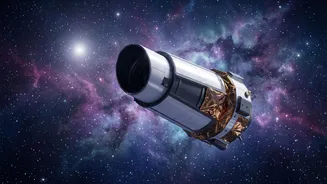
Launched on August 30, 2026, the Nancy Grace Roman Space Telescope is the next great step in space-based astronomy. It is named after Dr. Nancy Grace Roman, NASA's first chief of astronomy, who was instrumental in making the Hubble Space Telescope a reality.
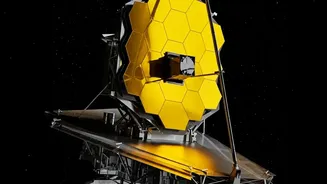
Now, her namesake observatory is set to build on Hubble’s legacy, not by replacing it, but by complementing it with a completely different approach to seeing the universe. While telescopes like Hubble and the James Webb Space Telescope (JWST) act like zoom lenses, studying specific objects in incredible detail, Roman is a panoramic mapping machine. It’s designed to survey huge portions of the sky with the same sharpness as Hubble but over a much larger area. The telescope is now on its journey to its operational orbit, about 1.5 million kilometers from Earth at a stable gravitational point known as Lagrange Point 2, where the JWST also resides.
The Power of a Wide-Angle Lens
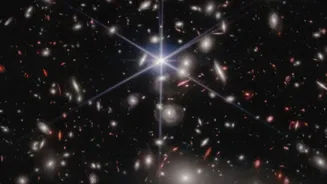
The key to Roman’s power is its Wide Field Instrument (WFI). This 300.8-megapixel camera gives the telescope a field of view at least 100 times larger than Hubble's infrared camera. To put that in perspective, where Hubble might capture a single galaxy in stunning detail, a single snapshot from Roman could contain millions of them. This capability is the foundation of a large sky survey, an astronomical map of a huge region of space used to catalog celestial objects and perform statistical analysis. Over its five-year primary mission, Roman is expected to image more than 50 times the area of sky that Hubble has covered in its entire 30-plus years of operation. This will generate an unprecedented amount of data—around 20 petabytes—creating the largest cosmic panoramas ever made from space and enabling a new era of big-data astronomy.
Hunting for Dark Energy and Dark Matter
One of Roman’s primary goals is to tackle one of the biggest mysteries in physics: dark energy. This unknown force is believed to be responsible for the accelerating expansion of the universe, but scientists know very little about it. Roman will investigate dark energy using three different methods. It will measure the distribution of billions of galaxies, observe distant supernovae, and study how the light from galaxies is bent by gravity, a phenomenon called weak gravitational lensing. By mapping the cosmos on such a grand scale, Roman will provide crucial data on how the universe's expansion has changed over time, giving scientists clues about the nature of dark energy. It will also help map the presence of invisible dark matter by observing its gravitational effects on the visible matter that Roman can see directly.
A Census of Distant Worlds
Beyond cosmology, Roman is set to revolutionize the search for exoplanets, or planets orbiting other stars. While missions like Kepler and TESS found thousands of planets by looking for the dimming of starlight as a planet passes in front of its star (the transit method), Roman will primarily use a different technique called gravitational microlensing. This occurs when a star with a planet passes in front of a more distant star, and its gravity acts like a lens, briefly magnifying the background star’s light. This method is sensitive enough to find planets down to the mass of Mars and even so-called rogue planets that don't orbit a star at all. Astronomers predict Roman could discover over 100,000 exoplanets, including multi-planet systems, providing a massive statistical survey of the types of worlds that exist in our galaxy.
Seeing Planets Directly
In addition to its wide-field survey work, Roman carries a technology demonstrator called the Coronagraph Instrument. This device is designed to block the overwhelming glare from a star, allowing the telescope to take direct images of giant exoplanets orbiting it. This is incredibly difficult, as a planet can be a billion times fainter than its host star. The coronagraph will test advanced starlight-suppression technologies that could be used on future missions, like the planned Habitable Worlds Observatory, which aims to take direct images of Earth-like planets. By proving this technology, Roman is paving the way for the ultimate search for life elsewhere in the universe.