

A Glimpse into Our Sun's Future
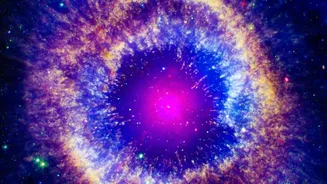
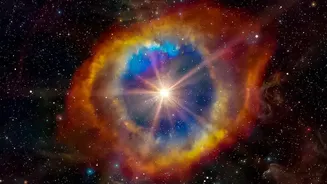
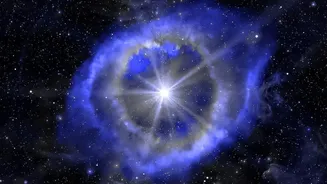
The subject of Webb’s latest portrait is a planetary nebula known as NGC 2392, or the Lion Nebula, located thousands of light-years away. A planetary nebula has nothing to do with planets; it’s the name given to the expanding, glowing shells of gas cast
off by a dying star. For stars that aren't massive enough to explode in a supernova, this is their final, graceful act. At the heart of this celestial artwork lies a white dwarf—the super-dense, Earth-sized core of the star that was. This tiny remnant is incredibly hot, and its intense radiation is now illuminating the very layers it shed, creating the breathtaking structure we can see. In a way, observing NGC 2392 is like looking into the distant future of our own solar system.
Webb's Powerful Infrared Eyes
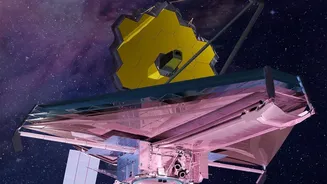
While the Hubble Space Telescope gave us beautiful views of the Lion Nebula in the past, the James Webb Space Telescope sees the universe in infrared light, allowing it to pierce through cosmic dust and reveal hidden structures with incredible clarity. Webb’s new images, taken with its Near-Infrared Camera (NIRCam) and Mid-Infrared Instrument (MIRI), expose the intricate complexity of the nebula's shells. What might have looked like a hazy cloud before is now resolved into distinct filaments, clumps of dust, and expanding bubbles of gas. This level of detail is crucial for scientists trying to understand the forces at play, moving beyond a static picture to a dynamic story of cosmic creation and destruction.
The Force of a Stellar Ghost
At the center of it all, the white dwarf acts as a powerful engine of change. Its fierce ultraviolet radiation blasts into the surrounding gas, creating a bubble of superheated, ionized material that expands outwards. This process is like a stellar snowplow, sweeping up gas and dust as it goes. This outward push from the central star is the primary force that begins to shape the nebula. However, this alone doesn't explain the strange and beautiful shapes we see. If it were just a simple expansion, all planetary nebulae would be perfect spheres. But they aren't. Many, like the Lion Nebula, are strikingly complex and asymmetrical, hinting that another force is at work.
An Invisible Cosmic Sculptor
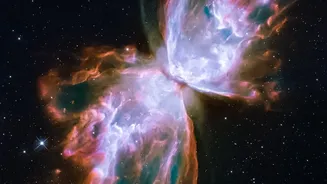
This brings us to a major puzzle in astrophysics: why do planetary nebulae come in such varied shapes, from hourglasses to butterflies and, in this case, a lion's mane? The leading theory is that powerful magnetic fields, generated by the dying star, act as invisible sculptors. Much like how iron filings align around a bar magnet, the ionized gas ejected by the star would be guided along these magnetic field lines. Instead of expanding evenly in all directions, the material would be channeled into lobes, jets, and intricate rings. The star’s rotation and the presence of any companion stars could also add to the complexity, twisting the nebula into its final, unique form.
From Pretty Picture to Profound Physics
This is why Webb's new images are so important. They provide the most detailed map yet of the material that these invisible forces are acting upon. By studying the precise shape and structure of the Lion Nebula’s filaments and shells, astronomers can test their models of how magnetic fields shape the cosmos. They can compare the intricate reality captured by Webb with computer simulations to see if the magnetic hypothesis holds up. It’s a perfect example of how a major technological investment like the JWST delivers returns, turning a breathtaking cosmic image into a data-rich laboratory for solving fundamental questions about the life and death of stars.