



A Sweet Signal From Space
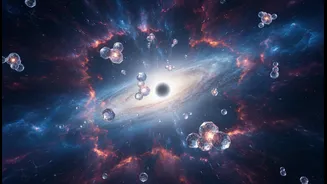
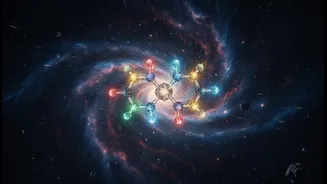
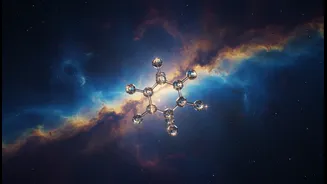
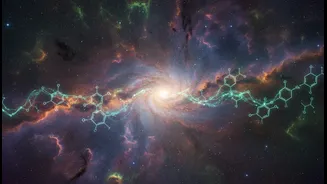
In a groundbreaking discovery, an international team of astronomers has detected a sugar molecule called erythrulose floating in a gas cloud near the center of the Milky Way. This isn't just any molecule; it's the first 'true' sugar, with a four-carbon
structure, to be found in interstellar space. On Earth, erythrulose is a simple sugar naturally found in foods like raspberries and is even used in some sunless tanning products. But finding it 27,000 light-years away provides powerful evidence that the raw ingredients for biology can form in the most extreme environments, long before planets even exist. This discovery was made by a team led by researcher Izaskun Jiménez-Serra, using powerful radio telescopes in Spain to analyse the unique chemical signature of the molecule in a vast molecular cloud known as G+0.693-0.027.
The Galaxy's Chemical Kitchen
The region near the centre of our galaxy is a chaotic and energetic place, but it's also what scientists call a rich chemical repository. These giant clouds of gas and dust, while cold and diffuse, act as cosmic factories. Over millions of years, simple atoms cling to icy dust grains and combine to form increasingly complex molecules. While scientists have found hundreds of molecules in space before, including simpler ones related to sugars, the detection of erythrulose is a major step up. Surprisingly, the study found that this four-carbon sugar was at least eight times more abundant than any simpler three-carbon sugars, which were not detected at all. This challenges the long-held idea that molecules in space grow slowly, one carbon atom at a time, suggesting a more efficient pathway where two-carbon molecules might combine directly on dust grains.
From Stardust to Life's Building Blocks
So, why is finding sugar in space so important? Sugars are fundamental to life as we know it. They are not just a source of energy; they form the very backbone of RNA and DNA, the molecules that carry our genetic code. One of the biggest questions in science is how these essential molecules first appeared on early Earth. Laboratory experiments to create sugars under early-Earth conditions have not produced them in sufficient quantities. This discovery supports an alternative theory: that the building blocks of life didn't have to form on Earth at all. Instead, they could have been created in interstellar space and delivered to our young planet via comets and asteroids during a period known as the Late Heavy Bombardment, billions of years ago. Scientists estimate that millions of tonnes of erythrulose could have reached Earth this way.
A New Chapter for Astrobiology
The detection of erythrulose truly marks the beginning of a new phase in astrobiology, the study of life's origins and potential existence elsewhere in the universe. While erythrulose is not part of our DNA, it is a close chemical relative to the sugars that are, like ribose. In wet environments, erythrulose can easily transform into other sugars that are believed to be precursors to the first nucleic acids, which evolved into RNA and DNA. Finding it proves that the universe is capable of making complex, chiral molecules—those that can exist in left- and right-handed forms, a key property of life's molecules—in the harsh conditions of deep space. It shows that the cosmic recipe for life might be more common across the galaxy than we previously thought, opening up the thrilling possibility that life could develop elsewhere.