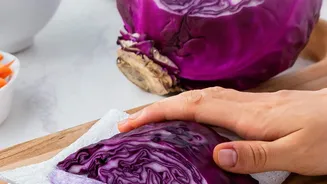








What if a simple vegetable from your kitchen could perform a bit of 'magic'? Purple cabbage holds a colourful secret, transforming into a vibrant, home-made science experiment with just a few common household ingredients.
A Splash of Kitchen Chemistry
It might sound like a trick, but
it's pure chemistry. The deep purple liquid extracted from red cabbage leaves can act as a natural pH indicator. This means it can visually show whether a substance is acidic or alkaline (basic) by changing its colour. When you introduce different substances to the juice, you'll see a spectacular shift, creating a rainbow of colours from bright pink to green and even yellow. This phenomenon turns a humble vegetable into a fantastic tool for exploring the scientific properties of everyday items found right in your pantry and cleaning cabinet, from lemon juice to baking soda.
The Science Behind the Spectacle
The secret ingredient behind this colourful display is a pigment molecule called anthocyanin. This is the same water-soluble compound that gives many fruits and flowers, like blueberries and grapes, their rich red, purple, and blue hues. Anthocyanin molecules change their structure depending on the concentration of hydrogen ions in a solution, which is what the pH scale measures. In simple terms, when the cabbage juice is mixed with an acid, the anthocyanin turns a reddish-pink colour. When mixed with a base, or alkali, it shifts towards blue, green, or yellow. A neutral substance, like pure water, will leave the juice its original purplish colour.
How to Make Your Own Indicator
Creating your own pH indicator at home is surprisingly simple, though adult supervision is recommended, especially when using a stove or blender. You can either finely chop or tear a few purple cabbage leaves and steep them in hot water for about 10-15 minutes, or boil them for 5-10 minutes until the water turns a deep purple. Another method is to use a blender with some water to extract the juice more quickly. Once the liquid has cooled, strain out the solid cabbage pieces. The resulting purple liquid is your ready-to-use pH indicator. It can be stored in a sealed jar in the refrigerator for up to a week.
A Rainbow of Reactions
Now for the fun part: testing household substances. Pour a small amount of your cabbage indicator into several clear glasses. Then, add a few drops of different liquids to each glass and watch the colours change. Adding an acid like lemon juice or vinegar will produce a vibrant pink or red. Testing a weak base, like a solution of baking soda and water, will result in a blue or blue-green colour. Stronger alkalis, such as some soaps or window cleaners, can push the colour even further into green or greenish-yellow territory. This provides a visual spectrum of the pH scale using only items you already have. Just be sure to avoid very strong chemicals like bleach or drain cleaner for safety.
More Than Just Cabbage
While purple cabbage is one of the most effective and dramatic natural indicators, it's not the only plant that contains these colour-changing anthocyanins. Turmeric, for instance, is another common kitchen spice that works as a pH indicator, typically turning from yellow to a deep red in the presence of a base. The juice from blueberries, grapes, and even the petals of certain flowers like the China rose also exhibit similar colour-shifting properties. This recurring phenomenon in the plant world is a great reminder of how much fascinating science is hidden in plain sight, often waiting to be discovered in our own gardens and kitchens.