







The Ultimate Priority: A Safe Return
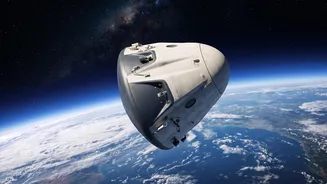
Sending humans to orbit and bringing them back is a complex dance of engineering and physics. While the powerful launch vehicle gets much of the attention, the success of the Gaganyaan mission truly hinges on the crew module's ability to survive a fiery
re-entry and splash down safely in the ocean. Getting this right is non-negotiable. To that end, the Indian Space Research Organisation (ISRO) is meticulously testing every component and sequence related to recovery. This methodical, safety-first approach is demonstrated by a recent push to complete a trio of crucial qualification tests, each designed to validate a different, life-critical moment in the module's return journey.
Test 1: Ensuring a Perfect Splashdown
Imagine a capsule returning from space. After it splashes into the sea, it might not be floating in the perfect, upright position. This is where the first test, for the Crew Module Up-righting System (CMUS), comes in. After a sea landing, the module needs to be correctly oriented so astronauts can be safely recovered by the Indian Navy. ISRO has developed a system using stored cold gas that inflates flotation bags, automatically rotating the module into the correct position. Recent successful qualification tests confirmed this system works as intended, ensuring that even in choppy seas, the crew module will remain stable and ready for the recovery teams.
Test 2: A Clean Break Before Re-entry
Before the crew module can begin its descent, it must cleanly separate from the Service Module, which contains the propulsion and power systems needed in orbit. This separation is handled by an umbilical connection system. During re-entry, this connection must detach at precisely the right moment without damaging the crew module or its heat shield. The second qualification test focused on this umbilical separation, simulating the forces involved to ensure the process is smooth and reliable. A flawless separation is vital, as any issue at this stage could compromise the module's trajectory and safe return. Passing this test provides confidence that the crew module will begin its journey back to Earth without a hitch.
Test 3: Surviving Parachute Deployment
The final moments of descent rely on a complex parachute system. But before the main parachutes can deploy, a protective cover called the Apex Cover must be blown away. This is done using small pyrotechnic thrusters. The third qualification test was designed to ensure the crew module's structure can withstand the force of this explosive separation. Engineers subjected a test version of the module to forces nearly twice what is expected during an actual flight. The structure passed, proving its design is robust enough to handle the violent-but-necessary event of jettisoning the cover to allow the parachutes to unfurl and slow the capsule for a gentle splashdown.
The Full Picture: More Than Just Tests
These three tests are part of a much larger qualification effort. ISRO has also been conducting Integrated Air Drop Tests (IADT), where a mock-up of the crew module is dropped from an aircraft to validate the entire parachute sequence, from the smaller drogue chutes that provide initial stabilisation to the massive main parachutes that ensure a soft landing. In parallel, ISRO and the Indian Navy have been conducting extensive recovery trials in open water. These mock operations involve naval ships, divers, and specialised equipment to practice locating, securing, and retrieving the capsule from the Bay of Bengal as quickly as possible. Every successful trial, from ground tests to at-sea drills, refines the standard operating procedures and builds the immense skill and coordination required for a real-world recovery.