


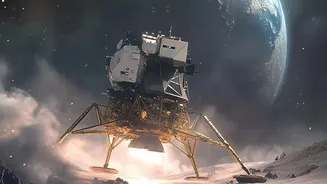
Meet IMAP: Our Cosmic Cartographer
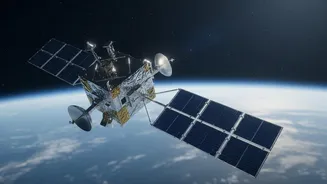
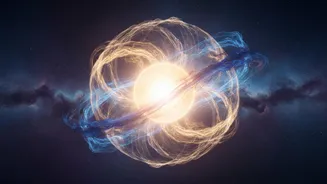
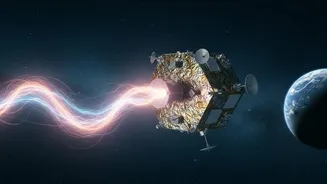
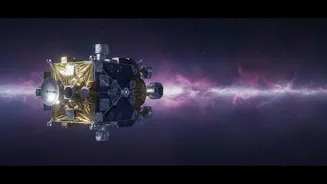
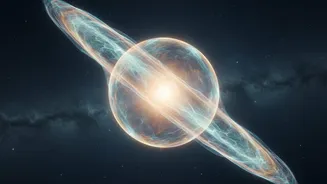
Launched in late 2025, NASA's Interstellar Mapping and Acceleration Probe (IMAP) is a state-of-the-art observatory on a crucial mission. Its job is to study the heliosphere, the vast magnetic bubble that the Sun creates around our solar system. Think
of it as a protective shield, inflated by a constant stream of charged particles from the Sun called the solar wind. This bubble deflects a significant amount of harsh galactic cosmic radiation that would otherwise bombard the planets, including Earth. Positioned about 1.5 million kilometres from Earth, IMAP has an unobstructed view to map this entire boundary. Using 10 different instruments, it 'listens' and 'sees' particles coming from the Sun and from interstellar space, helping scientists understand where our cosmic neighborhood ends and the rest of the galaxy begins.
Understanding the 'Solar Bubble'
The heliosphere is not a static object; it's a dynamic, interactive boundary. The solar wind pushes outward for billions of kilometres, far beyond Pluto, until its pressure is finally balanced by the pressure of the interstellar medium—the gas and dust that fills the space between stars. This creates several distinct regions. The area where the solar wind abruptly slows down is called the termination shock. Beyond that is a turbulent region called the heliosheath, and the final boundary where the solar wind's influence stops is the heliopause. Understanding this structure is vital. It not only tells us about the nature of our Sun and the local galactic environment but also provides insights into what makes a solar system habitable, a key question in the search for life elsewhere in the universe.
The First Data Drop Is Here
In a significant milestone, NASA and the IMAP team at Princeton University released the first batch of science data to the public on August 7, 2026. This release includes measurements collected through April 2026 from seven of the probe's ten instruments. This isn't just a data dump for elite scientists; it's an open invitation for the global community to explore the raw information that is shaping our understanding of space. The data comes from instruments that measure the solar wind's electrons and ions, high-energy particles, the interplanetary magnetic field, and even interstellar dust. This initial release marks the beginning of IMAP's two-year primary science mission, which officially started in February 2026.
How to Access the IMAP Data
So, how can you see this data for yourself? NASA has made the information accessible through dedicated online portals. The primary sources for the public are NASA's Space Physics Data Facility and the IMAP mission's data website, hosted by Princeton University. While some data files require specialized software, the mission team has provided user-friendly ways to engage. For instance, the IMAP Active Link for Real-Time (I-ALiRT) data stream is designed for space weather forecasters but offers fascinating quick-look plots online. Some of this real-time data, like solar wind speeds and temperatures, is even fed into public-facing websites like Space Weather Live, allowing anyone to see the conditions at IMAP's location.
A Beginner's Guide to Interpretation
Navigating scientific data can be intimidating, but you don't need a PhD to find it fascinating. Start with the visualizations and plots. One of IMAP's key jobs is to create all-sky maps using Energetic Neutral Atoms (ENAs). These are special particles created at the heliosphere's edge that travel in straight lines, unaffected by magnetic fields, bringing a direct message from the frontier. When you see a map from an ENA instrument like IMAP-Hi, you are looking at a picture of the solar system's boundary. Different colors will represent the intensity—or number—of particles detected from different directions. Bright spots might indicate areas where the interaction between the solar wind and the interstellar medium is particularly intense. By exploring these maps, you are looking at the very same pioneering data scientists are using to solve longstanding mysteries about our place in the galaxy.