



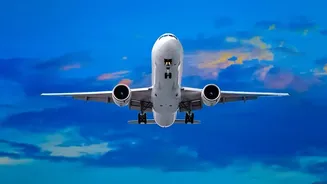
The feeling of a plane suddenly dropping can be unnerving for any passenger. But what feels like a stomach-lurching plunge is often a normal, controlled manoeuvre. Understanding why and how aircraft can descend so quickly is key to telling the difference.
A Normal Day at the Office
Believe it or not, a rapid descent is often just part of the flight plan. While a standard descent rate during approach to landing is usually gentle, around 2,000 to 3,000 feet per minute, pilots sometimes need to get down faster. Air Traffic Control (ATC) might instruct a pilot to descend quickly to maintain safe spacing from other aircraft or to fit into a busy arrival sequence. This is especially common in congested airspace around major airports. Pilots also use faster descents for efficiency. By staying at a higher, more fuel-efficient altitude for as long as possible and then performing a steeper, idle-thrust descent, airlines can save fuel. So, that feeling of dropping is often just the pilot taking a shortcut, all while being in complete control.
The Pilot's Toolkit for Descent
To descend without gaining excessive speed, pilots have specific tools at their disposal. The most noticeable of these are spoilers, also known as speed brakes. These are panels on the upper surface of the wings that the pilot can raise into the airflow. When deployed, spoilers disrupt the lift generated by the wings and significantly increase drag, allowing the aircraft to descend more steeply without accelerating. You might hear a distinct whooshing sound when they are used. Pilots can also reduce engine thrust to idle and in some cases, extend the landing gear to create additional drag, helping to slow the plane and increase the rate of descent. These tools give pilots precise control over the aircraft's energy and flight path.
The Emergency Scenario: Depressurisation
While most rapid descents are routine, there is one key emergency that requires this action: cabin depressurisation. Commercial jets fly at altitudes where the outside air is too thin to breathe. The cabin is pressurised to a comfortable, safe equivalent of about 8,000 feet. If the aircraft's structure is breached or the pressurisation system fails, the air inside will rush out. In this rare event, oxygen masks will drop, and the pilots' immediate priority is to perform an emergency descent to an altitude of around 10,000 feet, where the air is breathable again without supplemental oxygen. This is a critical and life-saving manoeuvre, executed according to rigorous training and procedures. The descent will be fast and steep, but it remains a controlled procedure designed to get everyone to safety as quickly as possible.
Turbulence Feels Different
It is important to distinguish a controlled descent from turbulence. A rapid descent is a smooth, deliberate manoeuvre where the plane is angled downwards. Turbulence, on the other hand, is caused by irregular air movements and results in erratic, bumpy, and unpredictable shaking. While pilots may sometimes descend to find smoother air and avoid turbulence, the chaotic feeling of being tossed around is very different from the sustained feeling of a steep, controlled drop. Aircraft are engineered to withstand severe turbulence, but the experience can be unsettling. A rapid descent, by contrast, is a sign that the pilots are actively managing the aircraft's flight path with precision.