

The Universe's Invisible Scaffolding
When you look up at the night sky, you're only seeing a tiny percentage of what makes up the universe. About 27% of the cosmos is thought to be dark matter, a mysterious substance we can't see or touch but whose gravitational effects are visible everywhere.
A further 68% is dark energy, an even more enigmatic force that is causing the expansion of the universe to accelerate. Together, these invisible components shape the cosmos on the grandest scales, forming a vast, web-like structure. Galaxies and galaxy clusters are not scattered randomly; they are found along the immense, invisible filaments of this 'cosmic web', separated by enormous voids. Understanding how this structure formed and evolved is one of the biggest challenges in modern science, and it requires a new way of looking at the universe.
A Cosmic Census of Billions of Galaxies
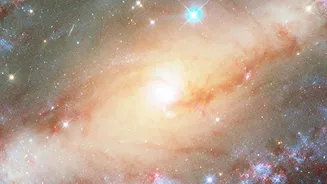
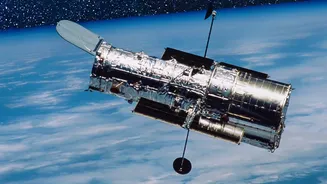
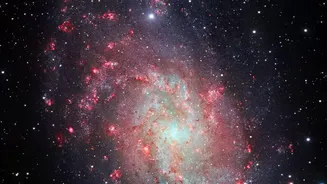
Enter the Nancy Grace Roman Space Telescope. Its primary mission includes a monumental undertaking called the High-Latitude Wide-Area Survey. This survey will map a huge portion of the sky, about 12%, capturing images of hundreds of millions, and potentially over a billion, galaxies. To put its power into perspective, Roman has a field of view 100 times larger than the Hubble Space Telescope's, allowing it to survey the sky at a speed that would take Hubble thousands of years to match. This isn't just about taking pretty pictures; the survey will create a 3D map of the cosmos, allowing scientists to see how the distribution of galaxies has changed over billions of years of cosmic history.
Seeing the Unseen Through a Cosmic Lens
So, how does Roman map something that is invisible by definition? It uses a clever technique called weak gravitational lensing. According to Einstein's theory of general relativity, massive objects bend the fabric of spacetime. As light from a distant galaxy travels to us, its path is slightly bent if it passes by a massive object, such as a clump of dark matter. This bending subtly distorts the apparent shape of the galaxy, like looking through a cosmic funhouse mirror. By measuring these tiny, systematic distortions in the shapes of millions of galaxies, Roman can create a map showing where the invisible dark matter is located. This will provide the most precise map of dark matter ever created, helping scientists test their models of how cosmic structures grow and evolve.
A New Generation of Cosmic Surveyors
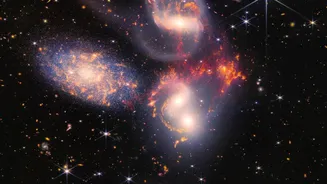
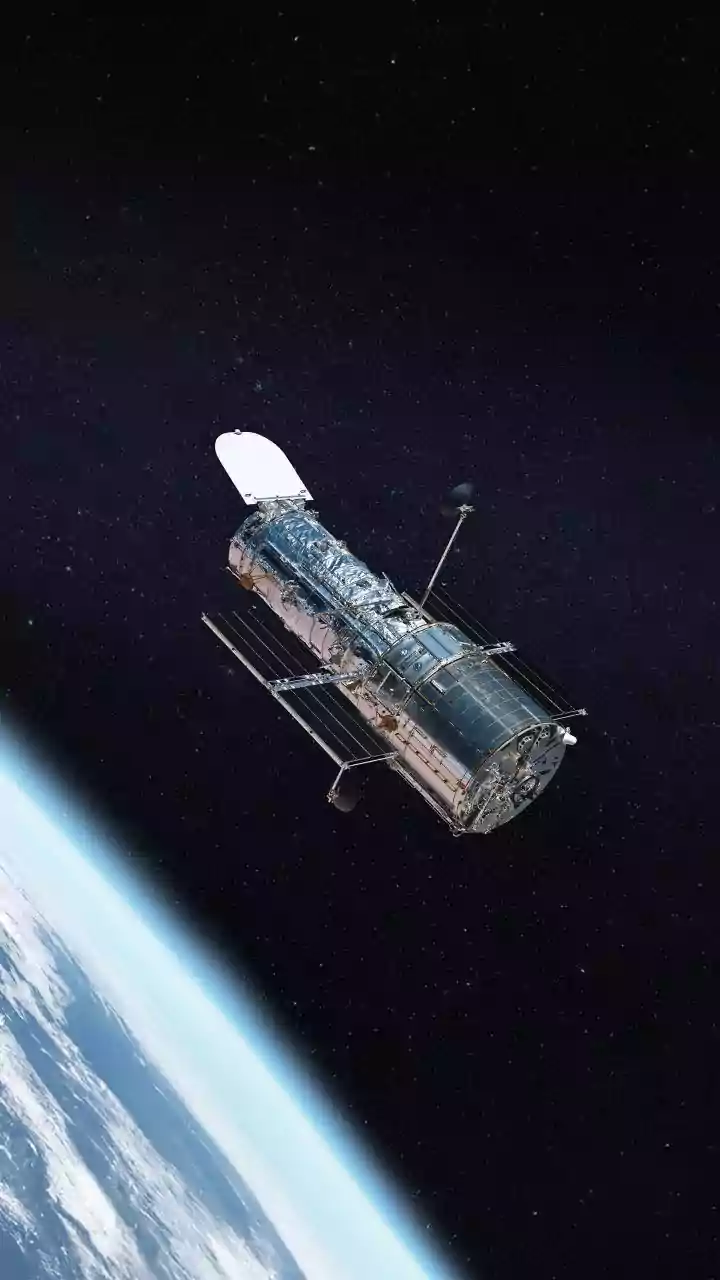
Roman is not alone in its quest to map the dark universe. It joins a fleet of powerful observatories, each with unique strengths. The Hubble Space Telescope provides incredibly detailed, high-resolution views of small patches of the sky. The James Webb Space Telescope can peer deeper into the infrared universe, capturing light from the very first stars and galaxies. Roman's strength is its panoramic vision; it's designed to be a survey machine, rapidly scanning huge sections of the sky to provide the big-picture context. Think of it this way: if Webb and Hubble are like photographers zooming in on a single tree in a forest, Roman is the one creating the map of the entire forest. It will also work in tandem with the European Space Agency's Euclid mission, which has similar goals. Together, these telescopes will provide a comprehensive view of the cosmos, from the finest details to the grandest structures.