

A Galactic Heavyweight Collision
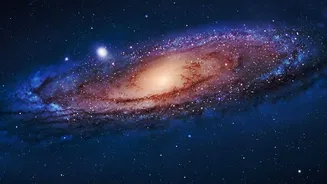
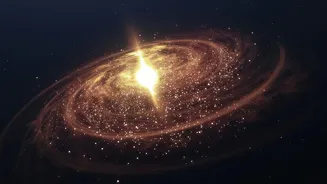
Our galaxy has a history of colliding with and absorbing smaller galaxies. New research presented in July 2026 suggests its most defining collision was a head-on crash with a dwarf galaxy about 10 to 11 billion years ago. Astronomers have named this long-gone
galaxy the Gaia-Sausage-Enceladus, or simply the Gaia Sausage. This is because data from the European Space Agency's (ESA) Gaia mission revealed that stars from this former galaxy now travel in elongated, sausage-shaped orbits within the Milky Way. This merger is considered the largest and most significant event in our galaxy's early history, fundamentally reshaping its structure.
The Cosmic Flip
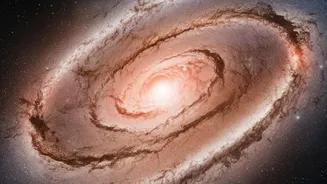
The most startling conclusion from the new research is that this ancient collision may have caused the entire disc of the Milky Way to gradually tilt by more than 90 degrees. In essence, our galaxy could have been completely flipped on its side over millions of years. Researchers from Durham University used powerful supercomputer simulations to study the evolution of Milky Way-like galaxies. They found that galaxies which experienced a massive head-on collision, like the one with the Gaia Sausage, were highly likely to undergo a dramatic "disc flip". This theory helps solve a long-standing puzzle: why the vast, sparse cloud of stars surrounding our galaxy, known as the stellar halo, rotates much more slowly than expected. The simulation showed that a disc flip is a common outcome for galaxies with slow-moving halos.
Uncovering Clues in the Stars
The evidence for this cosmic upheaval is written in the stars. The ESA's Gaia mission has been mapping the precise positions and movements of over a billion stars, creating an unprecedented 3D map of our galaxy and its history. By tracking the paths of stars, astronomers can essentially rewind time and reconstruct past events. The discovery of the Gaia Sausage itself came from identifying a large group of stars moving in peculiar, elongated orbits, distinct from the majority of the Milky Way's native stars. These odd orbits are the smoking gun of a dwarf galaxy that was torn apart and absorbed, confirming the massive collision.
An Ongoing Series of Impacts
While the Gaia Sausage collision was the most formative, it was far from the only one. The Milky Way has a long history of interacting with smaller satellite galaxies. Another notable offender is the Sagittarius dwarf galaxy, which has repeatedly smashed through the Milky Way's disc over the past six billion years. These collisions, while less dramatic than the Gaia Sausage event, have had profound effects. They are believed to have triggered major episodes of star formation, sending ripples through the galaxy's gas and dust. Some research even suggests that one of these passages may have helped trigger the formation of our own Sun about 4.7 billion years ago. This galaxy continues to orbit and merge with the Milky Way today.
Why This Cosmic History Matters
Understanding these ancient collisions does more than just satisfy our curiosity. It fundamentally changes our view of the Milky Way from a static island of stars to a dynamic, evolving structure. It helps explain the galaxy's current shape, including the warp in its disc and the bulge at its centre. Reconstructing this violent past allows scientists to place the Milky Way in the broader context of how all galaxies form and evolve. The fact that our galaxy's entire orientation may have been altered means that the Sun and countless other stars once followed very different paths. Piecing together this history helps us understand the forces that shaped our cosmic neighbourhood and our very existence within it.