







Not Fire, and Not a Rainbow
First, let's clear up the name. A 'fire rainbow' has nothing to do with fire, and it isn't technically a rainbow. The scientifically accurate name for this phenomenon is a circumhorizontal arc. The term 'fire rainbow' was likely coined around 2006 because
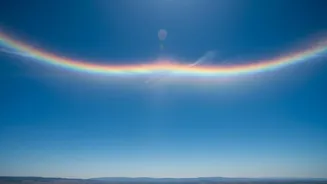
of the arc's flame-like appearance when it appears in wispy, fragmented clouds. Unlike a true rainbow, which is formed by the refraction and reflection of light in water droplets, a circumhorizontal arc is an ice halo, created by light interacting with ice crystals high up in the atmosphere. It always appears as a colourful band running parallel to the horizon.
The Perfect Recipe for a Sky Spectacle
For a circumhorizontal arc to appear, a precise set of conditions must be met. First, the Sun must be very high in the sky, at an elevation of at least 58 degrees above the horizon. This is why these arcs are more commonly seen in mid-latitude locations during the summer months and are impossible to see in places north of 55°N or south of 55°S. Second, there must be high-altitude cirrus clouds present. These thin, wispy clouds are so high that they are composed of millions of tiny, plate-shaped hexagonal ice crystals instead of water droplets.
How Ice Crystals Act Like Prisms
The magic happens when these ice crystals are aligned just right. The plate-like crystals must be oriented horizontally, parallel to the ground, so they can act as a collective giant prism. Sunlight enters through a vertical side face of a hexagonal crystal and exits through the bottom horizontal face. This 90-degree bend in the light's path causes it to refract, or separate, into its component colours, just like light passing through a prism. This process creates the distinct, pure spectral colours of the arc, with red on top and violet on the bottom. A traditional rainbow, by contrast, is formed opposite the sun by light refracting and reflecting inside liquid raindrops.
Why This NASA Image Is a Great Explainer
The image NASA shared on August 2, captured over West Virginia in 2021, is a fantastic example that helps visualize these conditions. It shows the circumhorizontal arc appearing in a patch of cirrus fibratus cloud. The photo clearly displays the phenomenon's distinct characteristics: it is parallel to the horizon and located far below the sun. By featuring such a clear image, NASA provides a textbook case for explaining how the specific alignment of the sun and horizontally oriented ice crystals in high-altitude clouds can produce such a vibrant, colourful display. It turns a beautiful but often misunderstood atmospheric sight into an accessible lesson in optics.
Distinguishing It From Other Sky Phenomena
Circumhorizontal arcs are sometimes confused with another phenomenon called cloud iridescence. While both create colourful clouds, there are key differences. Iridescent clouds have colours that appear more random and pastel-like, often described as looking like mother of pearl. A circumhorizontal arc, however, has the well-defined colour sequence of a rainbow (red, orange, yellow, etc.). Furthermore, an arc always appears at a specific spot below the sun, whereas iridescence can occur in various parts of the sky, often closer to the sun. Knowing these differences helps sky-watchers correctly identify the spectacular and relatively rare sight of a true circumhorizontal arc.